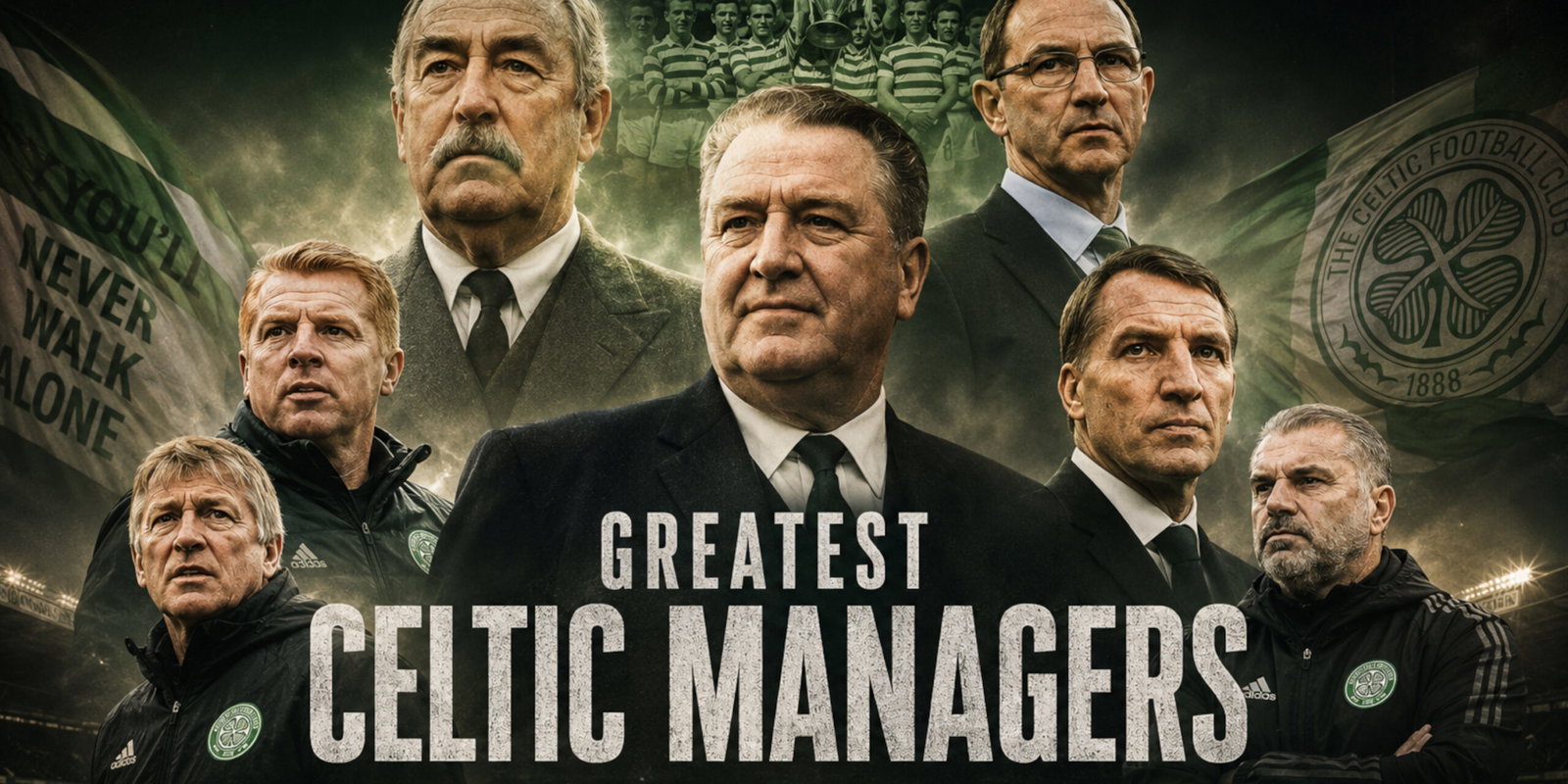
Ranking Celtic managers is a dangerous business. The club’s history stretches across three centuries, different competitions, wildly different financial landscapes and several versions of Scottish football that barely resemble one another.
How do you compare Willie Maley building the foundations of Celtic with Jock Stein winning the European Cup? Where does Martin O’Neill’s UEFA Cup run sit beside Brendan Rodgers’ Invincibles? How much should Ange Postecoglou’s transformation count when his stay was relatively short?
For me, trophies matter, but they cannot be the entire argument. European performance matters. So does longevity, the quality of football, the condition of the club when a manager arrived and what remained after he left.
Some managers collected silverware with Celtic already dominant. Others had to make Celtic dominant again.
That distinction matters.
The Ranking Criteria
This ranking considers five broad areas:
| Factor | What matters |
|---|---|
| Domestic success | League titles, Scottish Cups, League Cups and sustained dominance |
| European performance | European Cup, Champions League, UEFA Cup and other continental campaigns |
| Transformation | How much stronger Celtic became during the manager’s tenure |
| Longevity | Ability to sustain success rather than simply produce one outstanding season |
| Legacy | Tactical, cultural and historical influence on Celtic |
Trophies naturally carry considerable weight, but context prevents this becoming a simple spreadsheet exercise.
A European trophy counts for rather a lot, as you might imagine.
1. Jock Stein
Celtic manager: 1965 to 1978
Major trophies: 25
League titles: 10
Scottish Cups: 8
League Cups: 6
European Cups: 1
There really isn’t much of an argument about first place.
Jock Stein took Celtic from a club that had won only one league championship since the war into champions of Europe.
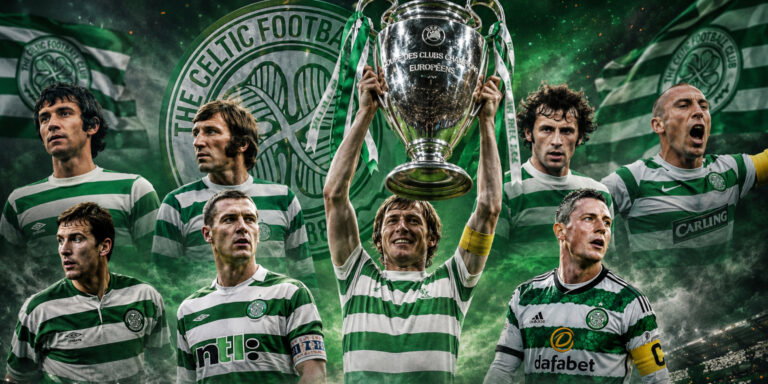
The 1966/67 season remains the high point of Celtic’s history. Celtic won every competition they entered, culminating in the European Cup final against Inter Milan in Lisbon.
The achievement becomes more extraordinary with time. Every player in the Lisbon Lions squad was born within roughly 30 miles of Celtic Park.
Stein’s Celtic were also aggressively attacking. Against Inter, Celtic had 42 attempts at goal. Inter’s defensive system was among the most sophisticated in European football, yet Celtic effectively spent the afternoon trying to kick its front door down.
It eventually worked.
Why Stein ranks first
The European Cup would probably be enough on its own. It wasn’t his only achievement.
Celtic won nine consecutive league titles from 1965/66 through 1973/74, reached another European Cup final in 1970 and became a genuine European power.
Stein changed Celtic’s sense of what was possible.
Every Celtic manager since has worked in the shadow of Lisbon.
Verdict: The standard against which everyone else is measured.
2. Willie Maley
Celtic manager: 1897 to 1940
League titles: 16
Scottish Cups: 14
Willie Maley presents the opposite problem to modern managers. His Celtic career was so long that it almost belongs to another form of football.
Maley managed Celtic for 43 years.
That sounds less like a managerial reign and more like ownership.
Under Maley, Celtic became one of Scotland’s dominant football institutions. His 16 league championships remain an extraordinary achievement, while the club also enjoyed a run of six consecutive league titles between 1904/05 and 1909/10.
His importance goes beyond the numbers.
Maley helped establish the culture of developing players, building teams rather than simply assembling them and expecting Celtic to compete for everything available.
There was no Champions League or modern European competition through which his Celtic could establish an international reputation. That makes direct comparison with Stein or O’Neill difficult.
Why Maley ranks second
If Stein created Celtic’s greatest team, Maley helped create Celtic as a footballing institution.
Forty-three years, 16 championships and 14 Scottish Cups is a managerial record unlikely ever to be approached again.
Verdict: The architect of Celtic’s first great footballing age.
3. Martin O’Neill
First spell: 2000 to 2005
League titles: 3
Scottish Cups: 3
League Cups: 1
UEFA Cup finals: 1
Martin O’Neill inherited a Celtic side that had finished 21 points behind Rangers in 1999/2000.
A year later Celtic won the domestic treble.
That turnaround is central to why I rank O’Neill so highly.
His team had power, experience and personality. Henrik Larsson produced some of the finest football of his career, Chris Sutton became an outstanding Celtic player, Neil Lennon controlled midfield and players such as Stiliyan Petrov developed around them.
O’Neill’s Celtic also carried genuine weight in Europe.
They defeated Juventus 4-3 at Celtic Park, beat Blackburn Rovers home and away, eliminated Liverpool from the UEFA Cup and eventually reached the 2003 UEFA Cup final in Seville.
Celtic lost 3-2 to Porto after extra time. Porto would win the Champions League the following season.
The case for O’Neill
There have been Celtic managers with more trophies, but relatively few changed the psychology around the club so quickly.
Before O’Neill, Rangers had dominated much of the 1990s. Under him, Celtic began behaving like the dominant force again.
The 2000/01 treble was the turning point.
Seville then restored Celtic’s reputation as a club capable of making a serious European run.
Verdict: The manager who dragged Celtic into a new era of confidence.
4. Brendan Rodgers
First spell: 2016 to 2019
Returned: 2023-2025
Notable achievement: Invincible domestic season and consecutive trebles during his first spell
Rodgers’ first Celtic team was brutally efficient domestically.
His opening season produced an unbeaten domestic campaign and a treble. Celtic finished the 2016/17 league season with 106 points, scoring 106 goals and losing none of their 38 league matches.
Across all domestic competitions, Celtic completed the season undefeated.
That is one of the cleanest displays of domestic superiority in the club’s history.
Rodgers followed it with another treble in 2017/18, creating what became the foundation of Celtic’s unprecedented run of four consecutive domestic trebles.
The European problem
This is where Rodgers loses ground on O’Neill.
His Celtic teams qualified for the Champions League group stage and produced individual moments of quality, but they never developed into a major European knockout force.
There were also some very heavy defeats.
That matters when comparing him with O’Neill, whose Celtic could credibly go toe-to-toe with strong European opposition.
Rodgers nevertheless modernised Celtic’s football considerably. Build-up play became more structured, pressing improved and players were developed within a clear tactical system.
His later return added another chapter to a relationship that has rarely been boring.
Verdict: One of Celtic’s greatest domestic managers, held back in this ranking by Europe.
5. Billy McNeill
Celtic manager: 1978 to 1983 and 1987 to 1991
League titles: 4
Scottish Cups: 3
League Cup: 1
Billy McNeill’s relationship with Celtic is so closely associated with his playing career that his managerial achievements can sometimes become secondary.
They shouldn’t.
McNeill won four league titles across two spells and produced one of the most emotionally significant seasons in Celtic’s history.
In 1987/88, Celtic’s centenary season, McNeill returned as manager and led the club to a league and Scottish Cup double.
That season has a special place in Celtic history.
McNeill understood the expectations around the club because he had helped create them as Stein’s captain.
Why McNeill belongs this high
His managerial career lacked the European breakthrough of Stein or O’Neill, but four championships across two different periods demonstrate considerable adaptability.
Winning the double during the centenary season pushes him further up the list for me.
Some seasons are remembered for statistics. Others become part of a club’s identity.
1987/88 is firmly in the second category.
Verdict: A Celtic giant as both captain and manager.
6. Ange Postecoglou
Celtic manager: 2021 to 2023
League titles: 2
Scottish Cups: 1
League Cups: 2
Domestic trebles: 1
Ange Postecoglou’s position depends heavily on how much value you place on transformation.
I place quite a lot on it.
Celtic finished 25 points behind Rangers in 2020/21. The squad required major reconstruction and Postecoglou arrived with relatively little profile in British football.
Within a season Celtic were champions again.
The recruitment was excellent. Kyogo Furuhashi, Jota, Cameron Carter-Vickers, Reo Hatate, Daizen Maeda and Matt O’Riley became major contributors.
More importantly, there was a clear footballing identity almost immediately.
Celtic pressed aggressively, attacked with numbers and played at a tempo that overwhelmed many domestic opponents.
The second season produced a treble.
What prevents him ranking higher?
Time.
Two seasons simply isn’t enough to place Postecoglou alongside Stein, Maley or O’Neill.
European results were also mixed. Celtic’s football occasionally looked promising against Champions League opposition, but promising performances don’t count for much once everyone has gone home and looked at the score.
Still, few managers have rebuilt Celtic so quickly.
Verdict: Short reign, enormous impact.
7. Gordon Strachan
Celtic manager: 2005 to 2009
League titles: 3
Scottish Cups: 1
League Cups: 2
Gordon Strachan might be the most underrated Celtic manager of the modern era.
Following Martin O’Neill was a horrible assignment. O’Neill’s team had enormous personalities and had taken Celtic to Seville.
Strachan had to rebuild it.
He won three consecutive league championships.
His Celtic sides also reached the Champions League last 16 in consecutive seasons, something that deserves greater recognition given Celtic’s later struggles to make an impression at that level.
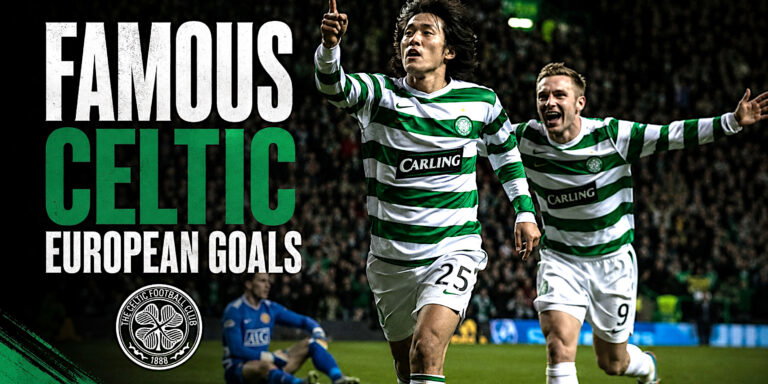
The victory over Manchester United in 2006, sealed by Shunsuke Nakamura’s magnificent free kick, remains one of Celtic Park’s great European nights.
Why Strachan tends to be underrated
His football was not always as expansive as Rodgers’ or Postecoglou’s, and he never had O’Neill’s emotional connection with the support.
But results are difficult to argue with.
Three championships and consecutive appearances in the Champions League knockout stage represents an excellent four-year return.
Verdict: Better than his reputation sometimes suggests.
8. Neil Lennon
Celtic manager: 2010 to 2014 and 2019 to 2021
Neil Lennon’s managerial legacy is complicated.
At his best, his Celtic teams produced some outstanding results.
The obvious example is Celtic 2 Barcelona 1 in November 2012.
Barcelona had roughly 89 per cent possession and attempted more than 20 shots. Celtic had very little of the ball and won anyway.
Football can occasionally be wonderfully unreasonable.
Celtic subsequently reached the Champions League last 16.
Lennon also delivered league titles across two managerial spells and returned during the 2018/19 season to complete the third consecutive domestic treble before leading Celtic to another treble the following campaign.
Why he isn’t higher
The collapse of the attempt to win ten consecutive league titles in 2020/21 damaged the final assessment of his second spell.
It was an extremely poor season by Celtic’s standards and ended with Rangers winning the championship by 25 points.
Yet it shouldn’t erase everything before it.
The Barcelona victory alone sits among Celtic’s greatest European results since Stein.
Verdict: Significant achievements, unforgettable European moments and a difficult final chapter.
9. David Hay
Celtic manager: 1983 to 1987
League titles: 1
Scottish Cups: 1
David Hay’s trophy total does not immediately jump from the page, but context matters.
His Celtic competed in an increasingly difficult Scottish landscape containing Alex Ferguson’s Aberdeen and Jim McLean’s Dundee United, as well as Rangers.
The defining achievement was the 1985/86 league title.
Celtic entered the final day needing to beat St Mirren heavily while hoping Hearts lost at Dundee.
Celtic won 5-0.
Hearts lost 2-0.
The championship went to Celtic on goal difference.
It remains one of the most extraordinary finishes to a Scottish league season.
Verdict: A shorter trophy list than others here, but responsible for one of Celtic’s most dramatic championships.
10. Wim Jansen
Celtic manager: 1997 to 1998
League titles: 1
League Cups: 1
One season.
That is the argument against Wim Jansen.
What happened during that season is the argument for him.
Rangers entered 1997/98 attempting to win a tenth consecutive league championship, which would have surpassed Celtic’s nine-in-a-row record under Stein.
Jansen stopped them.
Celtic won the championship on the final day by defeating St Johnstone 2-0.
He also signed Henrik Larsson.
That seems worth mentioning.
Larsson cost Celtic around £650,000 and became one of the greatest players in the club’s history.
Jansen left after only one season, so there was never an opportunity to build a dynasty.
But some managerial reigns are important because of what they prevent as much as what they win.
Verdict: Twelve months that changed Celtic’s modern history.
Celtic’s Greatest Managers Compared
| Manager | League titles | Defining achievement | European high point |
| Jock Stein | 10 | Lisbon Lions | European Cup winner |
| Willie Maley | 16 | Building Celtic’s first dynasty | Pre-European competition era |
| Martin O’Neill | 3 | Reversing Rangers’ dominance | UEFA Cup finalist |
| Brendan Rodgers | Multiple across two spells | Invincible domestic season | Champions League participation |
| Billy McNeill | 4 | Centenary double | European campaigns |
| Ange Postecoglou | 2 | Rapid rebuild and treble | Champions League group stage |
| Gordon Strachan | 3 | Three consecutive titles | Champions League last 16 |
| Neil Lennon | Multiple across two spells | Barcelona victory and domestic success | Champions League last 16 |
| David Hay | 1 | Love Street title triumph | European competition |
| Wim Jansen | 1 | Stopping Rangers’ ten-in-a-row | UEFA Cup campaign |
The table also exposes why ranking managers purely by trophies doesn’t quite work.
Maley won more league championships than Stein, but Stein conquered Europe.
Strachan achieved more in the Champions League than Postecoglou, but Ange transformed Celtic more dramatically.
Jansen won one league title, yet few Celtic championships have carried greater historical significance.
Context is everything.
Who Produced the Best Celtic Team?
There are several candidates depending on the measurement.
Best European team: Jock Stein’s 1966/67 side.
There is no serious alternative. They won the European Cup and every domestic competition available.
Best modern European side: Martin O’Neill’s 2002/03 team.
Seville settles that argument for me. Celtic went through Blackburn, Celta Vigo, Stuttgart, Liverpool and Boavista before losing narrowly to José Mourinho’s Porto.
Most dominant modern domestic team: Brendan Rodgers’ 2016/17 side.
An undefeated domestic treble and 106 league points is difficult to improve upon.
Best modern rebuild: Ange Postecoglou’s 2021/22 side.
Going from 25 points behind Rangers to champions while rebuilding much of the squad was exceptional.
The Managers Who Just Miss Out
Several Celtic managers have reasonable arguments for inclusion.
Jimmy McStay managed Celtic during the 1940s and won the Victory in Europe Cup, while Jimmy McGrory’s long managerial reign included major honours and the famous 7-1 League Cup final victory over Rangers in 1957.
Ronny Deila won consecutive league titles and helped introduce players who later became important under Rodgers.
Others played significant transitional roles without quite assembling a body of work strong enough for this top ten.
That is the difficulty with Celtic. You can leave successful managers outside the top ten and still have a defensible list.
Who Is Celtic’s Greatest Manager?
Jock Stein.
Willie Maley built the foundations. Martin O’Neill restored Celtic’s European confidence. Brendan Rodgers produced extraordinary domestic dominance. Billy McNeill represented the club perhaps better than anyone.
But Stein took Celtic somewhere no other Scottish club has ever been.
On 25 May 1967, Celtic became the first British club to win the European Cup.
That achievement sits above everything else.
For me, the most interesting debate isn’t really about first place. It starts below Stein.
Maley has longevity and unmatched domestic numbers. O’Neill has the strongest modern European record. Rodgers has remarkable domestic statistics. McNeill carries achievements across different eras, while Postecoglou produced one of the fastest transformations Celtic have seen.
Those arguments can run indefinitely.
Which, for Celtic supporters, is probably half the fun.