
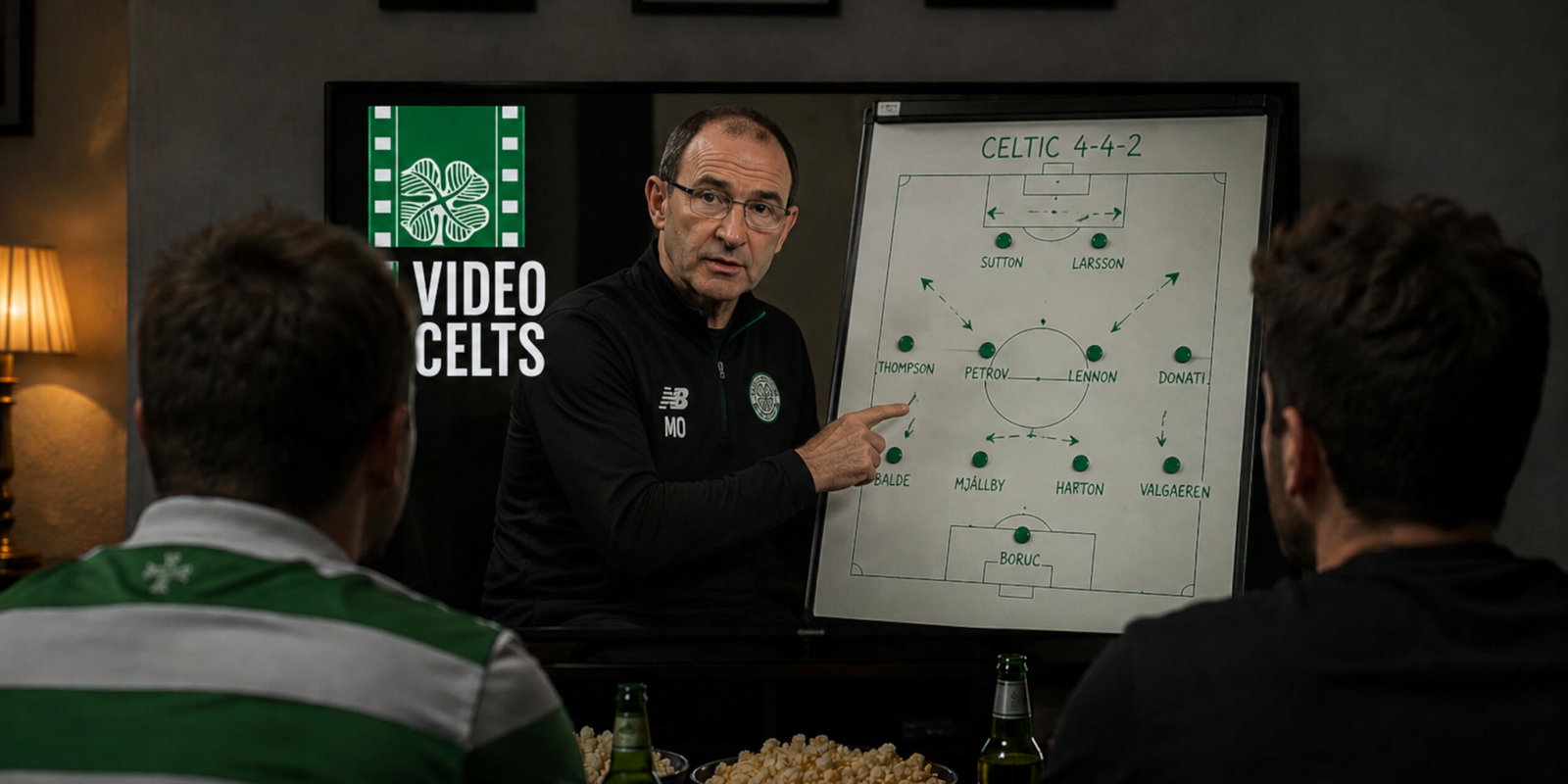
Martin O’Neill’s 2025 Return: Experience, Simplicity and Controlled Aggression
When Martin O’Neill returned to Celtic in 2025, the immediate question was obvious.
Could a manager associated so strongly with early-2000s power football still succeed in a tactical era dominated by inverted full-backs, automated pressing structures and build-up obsession?
Interestingly, O’Neill did not try to cosplay as a modern tactical theorist. He adapted selectively instead.
His latest Celtic side looked far calmer in possession than the thunderous version from his first spell, but many core principles remained recognisable.
The shape generally alternated between a 4-2-3-1 and a narrow 4-3-3:
- Double pivot protecting transitions
- Wingers staying higher and wider
- Full-backs providing measured overlap
- Aggressive counter-pressing after turnovers
- Quick vertical attacks once space opened
Unlike his original Celtic team, the 2025/26 side pressed in more coordinated waves rather than pure emotional aggression. There was clearer spacing between units and more caution against counter-attacks.
Still, the fingerprints remained obvious.
O’Neill still values:
- Physical midfielders
- Strong aerial presence
- Directness in key moments
- Fast attacks into the box
- Emotional momentum at Celtic Park
One thing especially noticeable in the modern spell was his preference for reducing unnecessary possession in harmless areas. Celtic circulated the ball when needed, but once forward lanes appeared, the instruction was usually immediate and aggressive progression.
There was less patience than many modern coaches prefer.
Frankly, O’Neill still seems suspicious of football becoming too tidy.
The Modern Pressing Structure
The biggest tactical evolution from O’Neill’s earlier era came without the ball.
His original Celtic side often pressed with raw intensity, forcing chaos through sheer aggression. The 2025/26 version looked more measured.
The press usually began with the centre-forward blocking central passing lanes while wide players curved inward to trap possession near the touchline.
Rather than chasing constantly, Celtic often waited for pressing triggers:
- Backward passes
- Poor first touches
- Slow switches of play
- Goalkeepers receiving under pressure
Once the trigger appeared, the intensity sharply increased.
This gave Celtic more defensive stability than some supporters expected. The side could remain compact for longer periods instead of burning energy in relentless pressing battles.
Full-Backs and Width in 2025/26
Modern football naturally changed the role of wide defenders.
In O’Neill’s first spell, full-backs largely supported traditional wing play. In 2025, they often tucked slightly inside during build-up phases before overlapping aggressively in advanced areas.
This helped Celtic maintain central control while still creating width high up the pitch.
The crossing game remained important though. O’Neill has never lost his belief that putting dangerous balls into the area creates stress defenders hate dealing with.
Some tactical fashions disappear. Panic in the six-yard box never does.
Why the 2025/26 Side Still Felt Familiar
Even with tactical evolution, there were unmistakable echoes of the old Celtic.
The mentality looked similar.
O’Neill’s teams still try to:
- Start quickly
- Crowd the box
- Dominate second balls
- Build emotional pressure
- Make Celtic Park feel overwhelming
That atmosphere remains central to his football philosophy. He understands momentum at Celtic is not purely tactical. It is psychological and territorial.
His teams want opponents to feel trapped.
The Original Martin O’Neill Celtic (2000-2005)
If the 2025/26 season showed adaptation, the 2000-2005 era showed pure force.
This was the team that dragged Celtic back into European relevance and re-established domestic dominance with football that felt huge in every sense.
The side combined:
- Physical power
- Ruthless directness
- Intelligent structure
- Elite attacking partnerships
- Relentless emotional intensity
At times they looked less like a football team and more like an organised avalanche.
The Core Shape
O’Neill’s classic Celtic side mainly operated in a powerful 4-4-2 or 3-5-2 formation.
The structure was simple on paper but highly effective:
- Solid central defensive pairing or trio
- Functional midfield balance
- Natural width
- Two aggressive forwards
- Heavy emphasis on crosses and second balls
Modern tactical analysis sometimes overcomplicates older systems. O’Neill’s approach worked because every role connected logically.
The team stretched opponents wide, attacked the box in numbers, and recovered loose balls aggressively.
No wasted movement. No decorative passing sequences for applause.
Everything had purpose.
Henrik Larsson and the Strike Partnership
Every tactical discussion eventually leads to Henrik Larsson.
O’Neill built the attack around maximising Larsson’s movement, intelligence and finishing.
Larsson drifted across the front line constantly:
- Pulling centre-backs out of shape
- Dropping deeper to combine
- Running channels
- Pressing defenders
- Arriving late into scoring areas
Alongside him, Chris Sutton and John Hartson offered physical dominance.
Sutton especially became tactically crucial.
He acted almost as a hybrid striker-midfielder:
- Winning aerial duels
- Linking attacks
- Occupying defenders
- Creating space for Larsson
It was one of the best strike partnerships British football produced during that era.
Midfield Control and Physicality
Neil Lennon anchored the midfield.
Lennon controlled tempo through intelligent positioning and fast recycling of possession. He rarely wasted passes and understood defensive spacing brilliantly.
Alongside him, Stiliyan Petrov brought vertical energy and transitional running.
Petrov’s ability to carry the ball through midfield gave Celtic a dangerous counter-attacking dimension in Europe.
The balance worked beautifully:
- Lennon stabilised
- Petrov accelerated
- Wide players stretched teams
- Strikers attacked constantly
Wide Play and Crossing
O’Neill loved natural width.
Players like Alan Thompson delivered some of the most dangerous crossing in Britain at the time.
Celtic attacked wide areas relentlessly:
- Early crosses
- Deep deliveries
- Far-post overloads
- Midfield runners attacking rebounds
Opponents often knew what was coming and still could not stop it.
There is something strangely demoralising about conceding the same type of goal repeatedly while 60,000 people roar approval around you.
Pressing and Atmosphere
The pressing was not modern gegenpressing in a tactical textbook sense, but it was ferocious.
Celtic hunted second balls aggressively and pressed emotionally as much as structurally.
At Celtic Park, this became overwhelming.
European sides often struggled with:
- Crowd intensity
- Physical duels
- Fast starts
- Constant crossing pressure
- Direct vertical attacks
O’Neill understood football crowds better than many tacticians do. His system amplified atmosphere instead of calming it down.
That mattered enormously in European nights.
European Adaptation
One underrated aspect of O’Neill’s management was pragmatism.
During the 2003 UEFA Cup run, Celtic defended deeper against stronger technical opponents and attacked transitions quickly.
Victories against clubs like Liverpool F.C. and Celta Vigo showed tactical maturity, not just passion.
The team could suffer without collapsing.
That resilience became a defining characteristic.
Why O’Neill’s Celtic is different
Many successful teams win trophies and fade into nostalgia.
O’Neill’s Celtic still feels alive because the identity was so strong.
Whether in 2001 or 2025, the core ideas remain visible:
- Physical authority
- Fast attacking transitions
- Aggressive mentality
- Emotional football
- Relentless pressure
The tactical details evolved with the era, but the personality remained unmistakable.
Martin O’Neill teams do not usually whisper their intentions.
They arrive like they mean business from the first whistle.





How we wish that Artur Boruc was Martin´s keeper … And is Harton the CB supposed to be John HARTSON ? And Donati instead of Didi Agathe … but AI problems aside … Very interesting article however .. we don´t really play aggressively and were very passive at times – the dreaded “horseshoe of death” Will a change of personnel in the midfield lead to a change in play ? Also will a change of shape (most fans long for 2 strikers – so could we switch back to a 352, I would probably say no as we have sold the perfect defender for a 3 (Nawrocki) .. but 442 would probably lead to overloads in the middle of the pitch, especially as most of the opponents play a midfield 3 against us, and our typical 2 (McGregor + An Other) currently at the club, would not fill me with lots of confidence. We could try a diamond rather than the typical 442 which could switch quickly in defensive off the ball to a 352 (If the sitting 6 – NOT CALMAC – was able to drop back as an auxiliary CB) .. however this would need the wide midfielders to be able to tuck in and reinforce the centre – Currently we don´t have that type of wide player (you couldnt put that role on lightweight players such as Tounekti or Yang, although to be fair to him Yang has improved on his off the ball defensive positioning. So AS the players that we have currently were bought for our current tactical set up , we are basically “Welded” to playing 433/4231 even tho as Joe has mentioned constantly our wingers do not produce the goal activities (assists or goals).
Need players before any of that sht.
Liked his big bruisers in his first spell who no agriculturally and thuggery ideology from opponents could neither match nor look at…
Hopefully he goes the same way again…
Though he put the club in a lot of debt and had to of course to match the eventually murdered ‘Rangers’ of the day before their death !
Off topic – But Sevco were pretty quick off the mark with their statement on The Scottish Cup Q/F ‘independent’ report on Wallow Wallow !
Wonder what Lucan will say…
F#ck All as per usual no doubt !