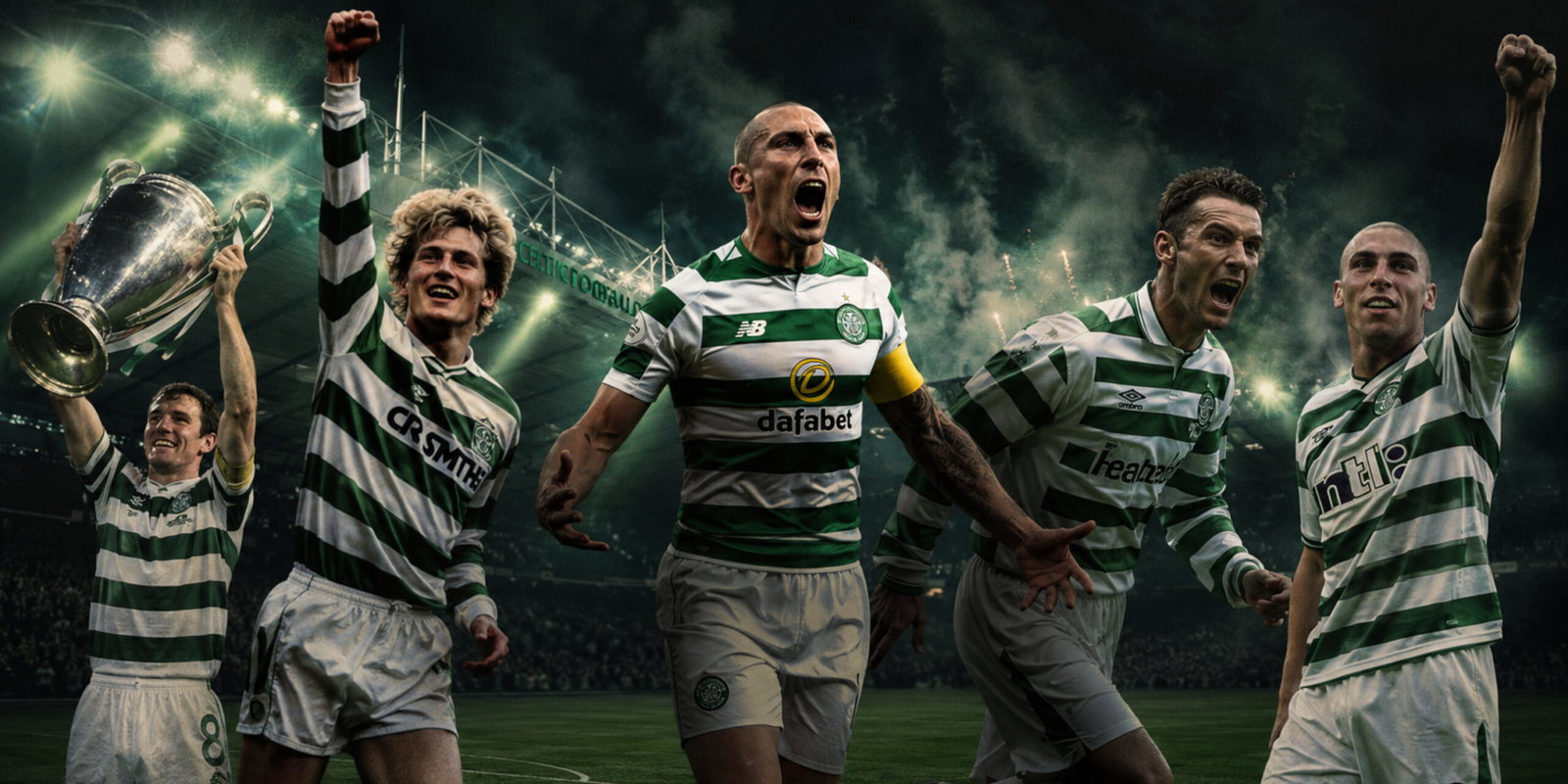
Some Celtic teams are remembered for the trophies they won. Others are celebrated for what their achievements meant to the club and its supporters.
Every generation has its favourites. Older supporters remember the brilliance of Jock Stein’s teams, while Martin O’Neill restored Celtic’s standing in British and European football at the beginning of the 21st century.
More recently, Brendan Rodgers and Ange Postecoglou have produced some outstanding domestic sides.
Comparing teams from different generations is difficult. Football has changed considerably, both on and off the pitch, but certain achievements deserve recognition regardless of the era.
Here are ten of the greatest Celtic teams of all time, ranked according to their success, quality of football and historical significance.
Ranking Criteria
Each team has been assessed using the following factors:
- Trophies won
- European performances
- League dominance
- Strength of opposition
- Playing style
- Historical importance
- Legacy at Celtic
Although winning trophies is an important consideration, the circumstances surrounding those achievements also deserve recognition.
Some teams on this list changed the direction of the club without winning as much silverware as others.
10. The 1987 to 1989 Centenary Team
Manager
Billy McNeill
Major Honours
| Competition | Achievement |
|---|---|
| Scottish League | Champions 1987/88 |
| Scottish Cup | Winners 1988 and 1989 |
There was considerable expectation surrounding Celtic’s centenary season after Billy McNeill returned to the club as manager in 1987.
Celtic celebrated their 100th anniversary by winning their first league and Scottish Cup double since 1977.
The Scottish Cup final against Dundee United provided a particularly memorable conclusion to the campaign.
With Celtic trailing, Frank McAvennie scored twice to secure a dramatic 2-1 victory at Hampden.
Roy Aitken, Paul McStay, Tommy Burns, Chris Morris and McAvennie were among the players who contributed to a season that remains especially fondly remembered.
McNeill’s team retained the Scottish Cup the following year, defeating Rangers 1-0 courtesy of a Joe Miller goal.
Although the side never achieved significant European success, its place in Celtic folklore is assured.
Winning the double in the club’s centenary year could hardly have been more fitting.
9. Wim Jansen’s Champions (1997 to 1998)
Manager
Wim Jansen
Major Honours
| Competition | Achievement |
|---|---|
| Scottish Premier Division | Champions |
| League Cup | Winners |
Few Celtic league titles have carried greater significance than the championship secured under Wim Jansen in May 1998.
Rangers had won nine consecutive league titles, leaving Celtic facing the prospect of their rivals surpassing the record established by Jock Stein’s team.
Jansen rebuilt the squad, bringing Henrik Larsson, Paul Lambert, Craig Burley and Marc Rieper to the club among several other signings.
Celtic secured the League Cup in November 1997, defeating Dundee United 3-0 at Ibrox.
However, the league championship remained the overriding priority.
On 9 May 1998, Celtic defeated St Johnstone 2-0 at Celtic Park to clinch the title.
Larsson opened the scoring before Harald Brattbakk added the second, finally allowing an anxious support to celebrate.
The team ended a decade-long wait for the league championship and prevented Rangers from winning ten successive titles.
In terms of restoring belief and changing the direction of Celtic, this side deserves its place among the club’s greatest.
8. Ange Postecoglou’s Treble Winners (2022 to 2023)
Manager
Ange Postecoglou
Major Honours
| Competition | Achievement |
|---|---|
| Premiership | Champions |
| Scottish Cup | Winners |
| League Cup | Winners |
Having secured a league and League Cup double during his first season in Scotland, Ange Postecoglou went one better in his second campaign.
Celtic’s attacking football, pressing and quick movement made them extremely difficult for domestic opponents to contain.
Kyogo Furuhashi provided the goals, supported by the creativity of players including Jota, Reo Hatate and Matt O’Riley.
Callum McGregor brought composure and experience to midfield, while Cameron Carter-Vickers became an important figure in defence.
Celtic’s league statistics were particularly impressive:
- 99 points
- 32 victories from 38 matches
- 114 goals scored
- Just 34 goals conceded
The League Cup was secured with a 2-1 victory over Rangers at Hampden.
Celtic subsequently retained the Premiership title before defeating Inverness Caledonian Thistle 3-1 in the Scottish Cup final to complete the treble.
European results remained a disappointment, with Celtic finishing bottom of their Champions League group.
Domestically, however, Postecoglou’s team produced some of the most entertaining football seen at Celtic Park in recent decades.
7. Neil Lennon’s Quadruple Treble Winners (2019 to 2020)
Manager
Neil Lennon
Major Honours
| Competition | Achievement |
|---|---|
| Premiership | Champions |
| Scottish Cup | Winners |
| League Cup | Winners |
Celtic’s fourth consecutive domestic treble represented an extraordinary achievement.
Neil Lennon’s team featured an impressive combination of established players and emerging talents.
Odsonne Edouard was a constant threat in attack, while Ryan Christie, James Forrest and Callum McGregor provided quality from midfield and wide positions.
Celtic also enjoyed some memorable European results, defeating Lazio home and away in the Europa League before finishing top of their group.
The domestic campaign was interrupted by the COVID-19 pandemic.
Celtic were subsequently declared league champions in May 2020 after the remaining Premiership fixtures were cancelled.
The Scottish Cup was completed later in the calendar year.
On 20 December 2020, Celtic defeated Hearts on penalties following a 3-3 draw at Hampden, completing the treble for the 2019/20 season.
That victory secured a fourth successive domestic treble, an achievement that will be extremely difficult for any Scottish club to replicate.
6. Brendan Rodgers’ Treble Winners (2017 to 2018)
Manager
Brendan Rodgers
Major Honours
| Competition | Achievement |
|---|---|
| Premiership | Champions |
| Scottish Cup | Winners |
| League Cup | Winners |
Following an unbeaten domestic campaign was always going to present a considerable challenge for Brendan Rodgers and his players.
Although Celtic could not maintain their unbeaten record throughout another season, they managed to retain all three domestic trophies.
James Forrest remained an important attacking player, while Scott Brown continued to provide leadership in midfield.
Kieran Tierney had established himself as a key figure in defence, and players such as Callum McGregor and Tom Rogic offered considerable technical quality.
Celtic secured the League Cup with a 2-0 victory over Motherwell.
The Premiership title was clinched in particularly memorable circumstances, with a 5-0 victory over Rangers at Celtic Park.
Another 2-0 win against Motherwell, this time in the Scottish Cup final, completed the domestic treble.
Celtic also participated in the Champions League group stage before transferring into the Europa League, where Zenit Saint Petersburg eliminated them in the round of 32.
The domestic achievement was significant in its own right.
Celtic had become the first Scottish club to win consecutive domestic trebles.
5. Martin O’Neill’s UEFA Cup Finalists (2002 to 2003)
Manager
Martin O’Neill
Major Achievements
| Competition | Achievement |
|---|---|
| Scottish Premier League | Runners-up |
| League Cup | Runners-up |
| UEFA Cup | Runners-up |
It may seem unusual to include a team that finished the season without a trophy among the greatest Celtic sides of all time.
However, Martin O’Neill’s UEFA Cup finalists deserve recognition for an outstanding European campaign.
Henrik Larsson, Chris Sutton and John Hartson gave Celtic a formidable attacking threat.
Alan Thompson provided quality from the left, while Neil Lennon and Stiliyan Petrov offered contrasting strengths in midfield.
Celtic eliminated Suduva, Blackburn Rovers, Celta Vigo, Stuttgart, Liverpool and Boavista on their way to the UEFA Cup final.
Among the most impressive results was a 2-0 victory over Liverpool at Anfield, with Thompson and Hartson scoring the goals.
Thousands of Celtic supporters travelled to Seville for the final against Porto.
Larsson scored twice, but Jose Mourinho’s side eventually won 3-2 after extra time.
Domestically, Celtic lost the league title to Rangers on goal difference and were also defeated by their Glasgow rivals in the League Cup final.
Despite finishing without silverware, the team had restored Celtic as a serious competitor in European football.
The journey to Seville remains one of the most important chapters in the club’s modern history.
4. Martin O’Neill’s Domestic Dominators (2000 to 2001)
Manager
Martin O’Neill
Major Honours
| Competition | Achievement |
|---|---|
| Scottish Premier League | Champions |
| Scottish Cup | Winners |
| League Cup | Winners |
Martin O’Neill inherited a Celtic side that had finished 21 points behind Rangers in the previous league campaign.
His impact was immediate.
The arrival of Chris Sutton strengthened the attack, while players such as Paul Lambert, Stiliyan Petrov and Johan Mjallby flourished under the new manager.
Henrik Larsson returned from his serious leg injury to produce an extraordinary season.
The Swedish striker scored 53 goals across all competitions, including 35 in the league, earning the European Golden Shoe.
An early indication of Celtic’s transformation arrived in August 2000, when O’Neill’s side defeated Rangers 6-2 at Celtic Park.
Celtic went on to win the league championship and both domestic cups.
A 3-0 victory over Kilmarnock secured the League Cup before another 3-0 win, against Hibernian in the Scottish Cup final, completed the treble.
It was Celtic’s first domestic treble since 1968/69.
Although Bordeaux eliminated the club in the second round of the UEFA Cup, the domestic campaign established the foundations for the European success that followed.
For supporters who had endured the frustrations of the 1990s, O’Neill’s first season represented a remarkable turnaround.
3. Brendan Rodgers’ Invincibles (2016 to 2017)
Manager
Brendan Rodgers
Major Honours
| Competition | Achievement |
|---|---|
| Premiership | Champions |
| Scottish Cup | Winners |
| League Cup | Winners |
Brendan Rodgers’ first season at Celtic produced one of the most dominant domestic campaigns in Scottish football history.
Celtic went unbeaten across all three domestic competitions, completing the treble without losing a single match.
The league statistics alone demonstrate the extent of their dominance.
| Record | Total |
|---|---|
| Domestic defeats | 0 |
| League matches won | 34 |
| League matches drawn | 4 |
| League points | 106 |
| League goals scored | 106 |
| Domestic trophies | 3 |
Moussa Dembele made an immediate impact following his arrival from Fulham, while Scott Sinclair became one of the most influential attacking players in the country.
Tom Rogic provided creativity in midfield, Kieran Tierney continued his emergence at left-back and Scott Brown enjoyed an impressive campaign as captain.
Celtic defeated Aberdeen 3-0 in the League Cup final.
The Scottish Cup final against the same opposition provided a dramatic conclusion to the season.
With the match level at 1-1, Rogic scored a stoppage-time winner to complete the unbeaten treble.
Although Celtic finished bottom of their Champions League group, their domestic performances established a standard that few Scottish sides have approached.
For domestic consistency across a single season, this team has a particularly strong claim to be Celtic’s greatest.
2. The Quality Street Gang Era (Late 1960s to Early 1970s)
Manager
Jock Stein
Major Honours
| Competition | Achievement |
|---|---|
| Scottish League | Multiple championships |
| Scottish Cup | Multiple victories |
| League Cup | Multiple victories |
One of the most remarkable aspects of Jock Stein’s tenure was his ability to develop another generation of outstanding players while the Lisbon Lions were still competing at the highest level.
The group of emerging talents became known as the Quality Street Gang.
Among those associated with this generation were:
- Kenny Dalglish
- Danny McGrain
- Lou Macari
- David Hay
- George Connelly
These players emerged at different stages, gradually joining or replacing established members of the Lisbon Lions squad.
Celtic reached another European Cup final in 1970, losing 2-1 to Feyenoord after extra time.
Further European Cup semi-final appearances followed in 1972 and 1974.
Domestically, the club completed nine consecutive league championships in 1974, having begun that run in 1965/66.
Rather than representing one particular starting eleven or season, the Quality Street Gang illustrates the successful transition between two generations of Celtic players.
Dalglish and McGrain would go on to become two of the finest footballers Scotland has produced.
The emergence of so many talented players from within Celtic’s own ranks remains one of the great achievements of the Stein era.
1. The Lisbon Lions (1966 to 1967)
Manager
Jock Stein
Major Honours
| Competition | Achievement |
|---|---|
| European Cup | Winners |
| Scottish League | Champions |
| Scottish Cup | Winners |
| League Cup | Winners |
| Glasgow Cup | Winners |
The Lisbon Lions remain Celtic’s greatest team.
On 25 May 1967, Jock Stein’s side defeated Inter Milan 2-1 at the Estadio Nacional in Lisbon to become the first British club to win the European Cup.
The achievement was made even more remarkable by the local origins of the team.
All eleven players who started the final were born within approximately 30 miles of Celtic Park.
Inter took the lead through Sandro Mazzola’s penalty, but Celtic continued to attack.
Tommy Gemmell equalised before Stevie Chalmers scored the winning goal, completing one of the most celebrated victories in British football.
Captain Billy McNeill lifted the European Cup, securing Celtic’s place in the history of the competition.
The European triumph was only one part of an extraordinary season.
Celtic also won the Scottish league championship, Scottish Cup, League Cup and Glasgow Cup, completing a clean sweep of the competitions they entered during the campaign.
Stein’s team achieved its success through an adventurous attacking approach that contrasted sharply with the defensive reputation of its Italian opponents.
No subsequent Celtic side has matched the combination of domestic and European success achieved by the Lisbon Lions.
Honours Comparison
| Team | League Titles | Domestic Cups | European Achievement |
|---|---|---|---|
| Lisbon Lions | 1 | 3 | European Cup winners |
| Quality Street Gang era | Multiple | Multiple | European Cup final and semi-final appearances |
| Rodgers Invincibles | 1 | 2 | Champions League group stage |
| O’Neill 2000/01 | 1 | 2 | UEFA Cup second round |
| O’Neill 2002/03 | 0 | 0 | UEFA Cup runners-up |
| Rodgers 2017/18 | 1 | 2 | Europa League round of 32 |
| Lennon 2019/20 | 1 | 2 | Europa League round of 32 |
| Postecoglou 2022/23 | 1 | 2 | Champions League group stage |
| Jansen 1997/98 | 1 | 1 | UEFA Cup first round |
| Centenary Team | 1 | 2 | European Cup second round in 1988/89 |
The domestic cup totals include the Scottish Cup and League Cup, with the Glasgow Cup also included for the Lisbon Lions.
Which Team Played the Best Football?
The answer largely depends on the type of football supporters enjoy watching.
The Lisbon Lions combined attacking ambition with considerable technical ability, demonstrating that a Scottish club could defeat Europe’s strongest opposition without abandoning its preferred style of play.
Brendan Rodgers’ Invincibles were particularly impressive in possession and rarely allowed domestic opponents to establish control of matches.
Martin O’Neill’s teams combined physical strength with the individual brilliance of players such as Henrik Larsson.
Ange Postecoglou’s Celtic played at a considerable tempo, using quick movement and aggressive pressing to overwhelm opponents.
Each side reflected the approach of its manager and provided supporters with plenty of memorable moments.
The Verdict
The Lisbon Lions remain the greatest Celtic team of all time.
Winning the European Cup with a starting eleven drawn entirely from the local area is an achievement that deserves recognition far beyond Scottish football.
Behind them, the debate becomes considerably more interesting.
Brendan Rodgers’ Invincibles have a strong claim to be the finest Celtic side in terms of domestic dominance across a single season.
Martin O’Neill’s teams restored Celtic’s domestic fortunes and brought the club back into contention for European silverware.
Ange Postecoglou delivered an entertaining brand of football alongside significant domestic success, while Billy McNeill and Wim Jansen produced achievements that carried enormous historical importance.
Every generation of Celtic supporters will have its own preferences.
Individual players, memorable matches and personal experiences inevitably influence how these teams are remembered.
The Lisbon Lions, however, continue to provide the benchmark against which every great Celtic side is measured.