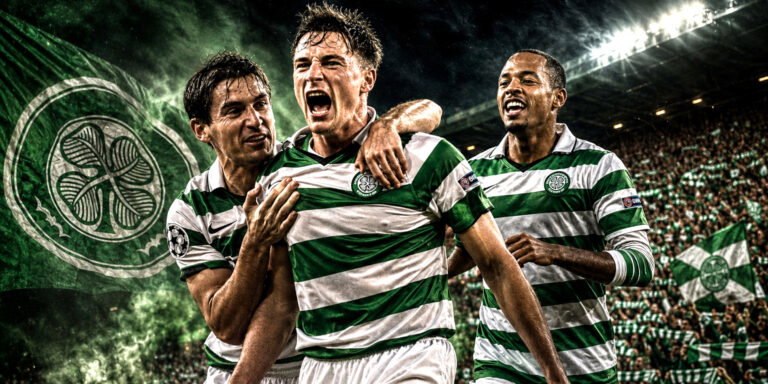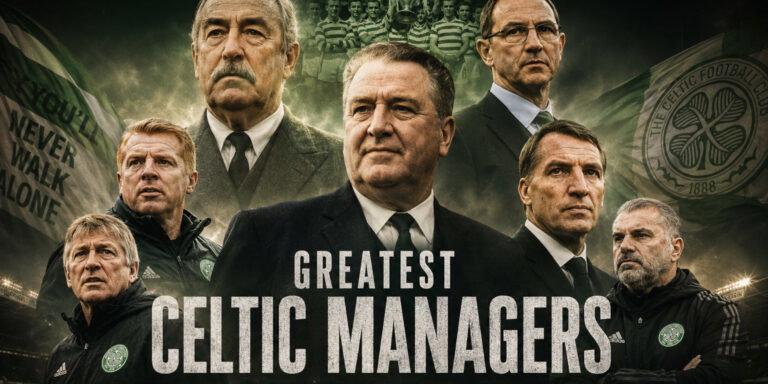
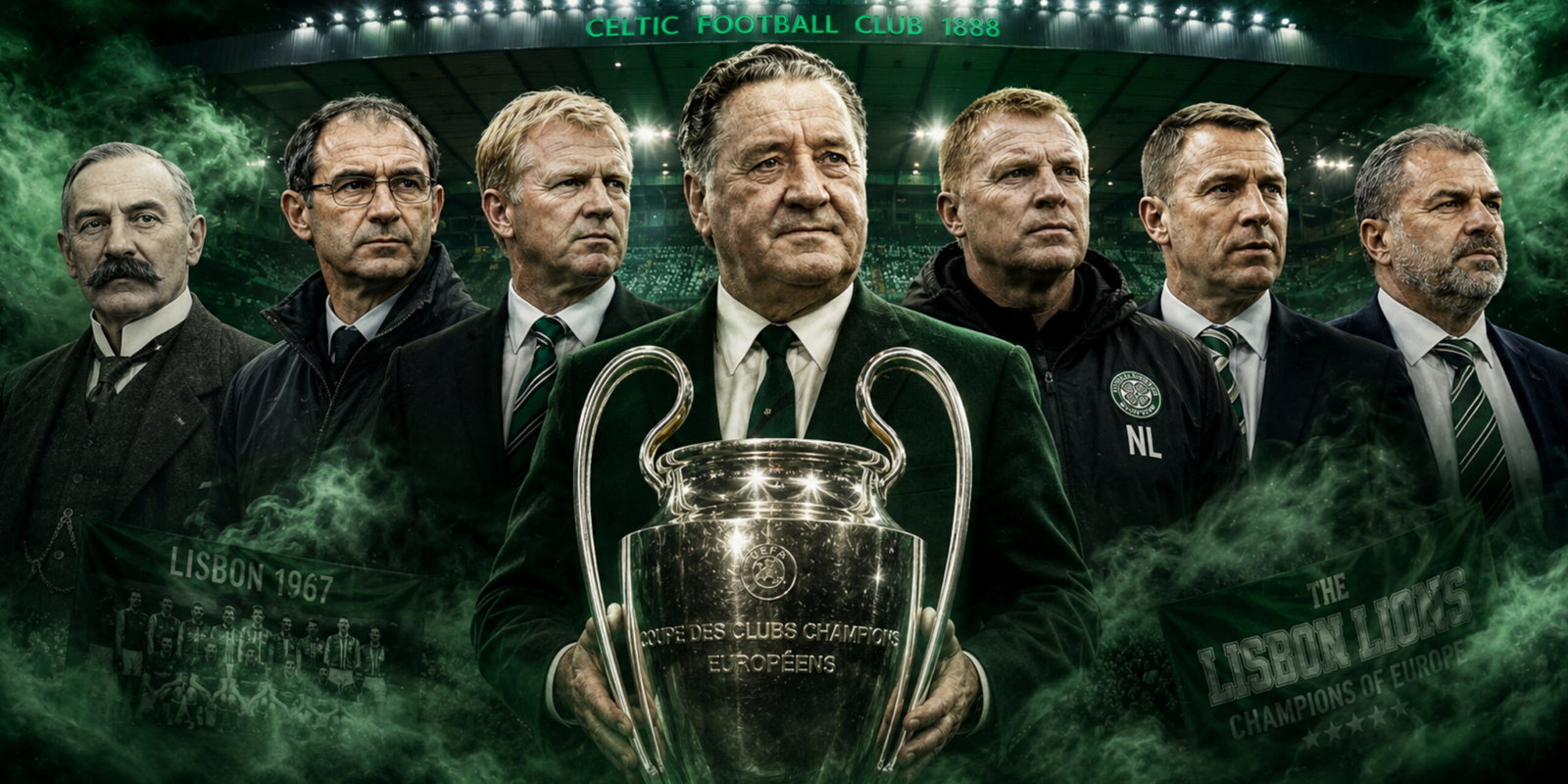
Success at Celtic is measured differently from most other clubs. Winning the league is expected, and even a domestic double can leave supporters wondering what might have been. European achievements, meanwhile, tend to live considerably longer in the memory.
Trophies are important, but context matters too. Some managers inherited championship-winning squads, while others took charge of a club in desperate need of rebuilding.
This ranking considers both the silverware delivered and the circumstances in which each manager worked.
Ranking Criteria
Managers were judged using several factors.
- Major trophies won
- European achievements
- Win percentage
- Long-term impact
- Quality of football
- Squad building
- Legacy among supporters
Longevity also matters. Delivering success in one season is impressive, but maintaining high standards over several years presents a different challenge.
The rankings primarily cover permanent Celtic managers, with notable interim appointments discussed separately.
Tier One: The Immortals
1. Jock Stein (1965 to 1978)
Few Celtic supporters would dispute the identity of the man at number one.
When Jock Stein returned to Celtic in 1965, the club had gone years without sustained domestic success. Within two years, they were champions of Europe.
Honours
- One European Cup
- Ten Scottish league titles
- Eight Scottish Cups
- Six League Cups
The Lisbon Lions famously defeated Inter Milan in 1967 with a starting eleven born within approximately 30 miles of Celtic Park.
Their attacking approach stood in stark contrast to the defensive football associated with their Italian opponents.
Stein also guided Celtic to another European Cup final in 1970, where they lost to Feyenoord, and delivered nine consecutive league championships between 1966 and 1974.
His record remains the benchmark for every Celtic manager who has followed him.
Legacy Rating: Untouchable.
2. Martin O’Neill (2000 to 2005, 2025, 2026 onwards)
Martin O’Neill inherited a Celtic side that had finished 21 points behind Rangers in the previous league campaign.
His impact became apparent almost immediately.
A 6–2 victory over Rangers in August 2000 announced a change in the balance of power, while his first season ended with a domestic treble.
Henrik Larsson enjoyed the most prolific campaign of his Celtic career, with Chris Sutton, and later John Hartson, providing formidable attacking support.
The outstanding achievement of O’Neill’s original tenure came in 2003, when Celtic reached the UEFA Cup final in Seville. Porto eventually prevailed 3–2 after extra time.
Victories over Liverpool, Barcelona and Juventus provided some of Celtic’s most memorable European occasions in the modern era.
O’Neill returned on an interim basis in October 2025 before taking charge again in January 2026.
His return delivered further success in May 2026, when Celtic secured the league championship before defeating Dunfermline Athletic 3–1 in the Scottish Cup final.
Celtic subsequently appointed him permanent manager in June.
Honours
- Four league titles
- Four Scottish Cups
- One League Cup
Few managers in Celtic’s modern history have enjoyed such a successful relationship with the club and its supporters.
3. Brendan Rodgers (2016 to 2019, 2023 to 2025)
Rodgers could hardly have enjoyed a better introduction to Scottish football.
Celtic went unbeaten throughout his first domestic campaign, winning all three available trophies in the process.
His team finished the 2016/17 league season with 106 points, scoring 106 goals and conceding just 25.
A second consecutive treble followed before Rodgers departed for Leicester City in February 2019.
Returning in June 2023, he delivered a league and Scottish Cup double before adding another championship and League Cup the following season.
Honours
- Four league titles
- Three Scottish Cups
- Four League Cups
European progress was more difficult, although Celtic reached the Champions League knockout phase play-offs in 2024/25 and came close to taking Bayern Munich to extra time.
Both of Rodgers’ departures generated controversy, but his record of 11 domestic trophies is difficult to argue with.
4. Willie Maley (1897 to 1940)
Willie Maley spent 43 years in charge of Celtic.
Having played in the club’s first-ever match against Rangers in 1888, he became Celtic’s inaugural secretary-manager in 1897.
Maley oversaw the emergence of some of the greatest sides in the club’s early history, including the team that won six consecutive league championships between 1905 and 1910.
His record includes:
- Sixteen league titles
- Fourteen Scottish Cups
Among the outstanding players who represented Celtic during his tenure were Jimmy Quinn, Patsy Gallacher and Jimmy McGrory.
Maley remains the most decorated Celtic manager in terms of major domestic trophies.
His influence on the development of the club makes him one of the most important figures in its history.
Tier Two: Modern Icons
5. Ange Postecoglou (2021 to 2023)
When Ange Postecoglou arrived from Yokohama F. Marinos in June 2021, many Celtic supporters knew relatively little about him.
He inherited a squad requiring considerable work after Rangers had ended Celtic’s run of nine consecutive league championships.
Despite losing three of his opening six league fixtures, Postecoglou recovered to win the championship in his first season.
His team played expansive, attacking football, with inverted full-backs and a relentless approach to possession becoming familiar features.
Honours
- Two league titles
- Two League Cups
- One Scottish Cup
Recruitment was central to his success.
Kyogo Furuhashi, Reo Hatate, Daizen Maeda, Cameron Carter-Vickers and Alistair Johnston were among the players signed during his tenure.
Celtic completed a domestic treble in his second season before Postecoglou left for Tottenham Hotspur.
Few managers have overseen such a substantial rebuild in such a short period.
6. Neil Lennon (2010 to 2014, 2019 to 2021)
The disappointing conclusion to Neil Lennon’s second spell sometimes overshadows what he achieved during his first.
Initially appointed on an interim basis following Tony Mowbray’s departure, Lennon won all eight of his remaining league fixtures in the 2009/10 campaign.
His first full season brought the Scottish Cup, followed by three consecutive league championships.
In Europe, a famous 2–1 victory over Barcelona in November 2012 helped Celtic reach the last 16 of the Champions League.
Honours
- Five league titles
- Four Scottish Cups
- One League Cup
Lennon returned following Brendan Rodgers’ departure in February 2019, completing Celtic’s third consecutive domestic treble.
Another treble followed in the delayed 2019/20 season.
The failure to secure a tenth consecutive league title damaged his managerial legacy, but ten major trophies and some outstanding European results deserve recognition.
7. Tommy Burns (1994 to 1997)
Tommy Burns won only one major trophy as Celtic manager, but his contribution went considerably further.
Taking over shortly after Fergus McCann’s takeover, Burns helped restore enthusiasm among supporters who had endured several difficult seasons.
His Celtic side played attractive attacking football, with players such as Pierre van Hooijdonk, Jorge Cadete and Paolo Di Canio providing memorable moments.
The 1995 Scottish Cup victory over Airdrieonians ended a six-year wait for a major trophy.
Celtic lost just one league match during the 1995/96 campaign, yet still finished four points behind Rangers.
Burns could not deliver the championship supporters desperately wanted, but he left behind a considerably stronger team than the one he inherited.
8. Wim Jansen (1997 to 1998)
Wim Jansen spent just one season in charge of Celtic, but few managerial appointments have carried greater significance.
Rangers were pursuing a tenth consecutive league title when the Dutchman arrived in 1997.
Celtic eventually secured the championship on the final day of the season, defeating St Johnstone 2–0 at Celtic Park.
Jansen also won the League Cup, beating Dundee United 3–0 in the final at Ibrox.
Perhaps his greatest long-term contribution was bringing Henrik Larsson to Scotland. The Swedish forward scored 19 goals in all competitions during his debut season.
Jansen departed shortly after securing the title, leaving supporters to wonder what might have followed had he stayed.
Tier Three: Major Contributors
9. Gordon Strachan (2005 to 2009)
Replacing Martin O’Neill was never going to be straightforward.
Strachan’s first competitive match ended in a 5–0 defeat to Artmedia Bratislava, hardly the introduction he would have wanted.
Nevertheless, he recovered to win three consecutive league championships, one Scottish Cup and two League Cups.
Celtic also reached the last 16 of the Champions League in consecutive seasons, recording memorable home victories over Manchester United and AC Milan along the way.
His football did not always win over the support, particularly towards the end of his tenure.
However, six major trophies and two appearances in the Champions League knockout stages represent an impressive record.
10. Billy McNeill (1978 to 1983, 1987 to 1991)
The captain of the Lisbon Lions enjoyed two successful spells as Celtic manager.
His first league championship arrived in dramatic fashion in 1979, when ten-man Celtic defeated Rangers 4–2 to secure the title.
Two further championships followed before McNeill left for Manchester City in 1983.
Returning four years later, he guided Celtic to a memorable league and Scottish Cup double during the club’s centenary season.
Across both spells, McNeill won four league titles, three Scottish Cups and one League Cup.
The circumstances surrounding his departure in 1991 cannot diminish his achievements as either a player or manager.
11. Davie Hay (1983 to 1987)
Davie Hay took charge during a particularly competitive period in Scottish football.
Aberdeen and Dundee United were challenging the traditional dominance of Celtic and Rangers, making domestic success far from straightforward.
Hay won the Scottish Cup in 1985 before delivering a memorable league championship the following year.
Celtic’s 5–0 victory over St Mirren on the final day, combined with Hearts losing at Dundee, secured the title on goal difference.
With Paul McStay and Brian McClair among his players, Hay assembled an accomplished attacking side.
His achievements can sometimes be overlooked between Billy McNeill’s two spells in charge.
12. Ronny Deila (2014 to 2016)
Ronny Deila arrived from Norwegian football with ideas about fitness, nutrition and player development.
The former Strømsgodset manager won consecutive Scottish league championships and the 2015 League Cup.
His first league campaign was particularly impressive defensively, with Celtic conceding just 17 goals in 38 matches.
Kieran Tierney also established himself in the first team during Deila’s tenure.
Failure to qualify for the Champions League group stage in either season ultimately undermined his position.
Despite those European disappointments, Deila left Celtic with three major trophies and several talented young players who would contribute to future success.
13. Jimmy McGrory (1945 to 1965)
Jimmy McGrory’s extraordinary goalscoring record as a Celtic player often receives more attention than his two decades as manager.
His time in charge included several outstanding achievements.
Celtic won the Coronation Cup in 1953, defeating Hibernian in the final, before completing a league and Scottish Cup double the following season.
The famous 7–1 League Cup final victory over Rangers in 1957 remains one of the most celebrated results in the fixture’s history.
However, McGrory won just one league championship in 20 years.
Boardroom involvement in team affairs restricted his authority, providing important context when assessing his managerial record.
In total, McGrory won five major domestic trophies alongside the Coronation Cup.
Tier Four: Mixed Records
14. Jozef Vengloš (1998 to 1999)
Replacing Wim Jansen after Celtic’s historic championship victory was a difficult assignment.
Jozef Vengloš endured a challenging start, although a memorable 5–1 victory over Rangers in November 1998 helped improve his standing among supporters.
His most significant contribution came through recruitment.
The arrivals of Lubomír Moravcík and Johan Mjällby proved inspired, with both players going on to enjoy considerable success under Martin O’Neill.
Celtic finished second in the league and lost the Scottish Cup final to Rangers.
Although Vengloš departed without winning a trophy, his signings strengthened the club well beyond his single season in charge.
15. Liam Brady (1991 to 1993)
Liam Brady became the first permanent Celtic manager who had not previously played for the club.
He inherited a difficult situation, with Rangers enjoying considerably greater financial resources and Celtic facing growing problems off the pitch.
Brady brought future captain Tom Boyd to the club in 1992, but his side failed to reach a major domestic cup final or mount a successful championship challenge.
He resigned in October 1993 without winning a trophy.
His distinguished playing career remains considerably more successful than his time in football management.
16. Lou Macari (1993 to 1994)
Lou Macari returned to Celtic during one of the most turbulent periods in the club’s history.
His tenure began with a 2–1 victory over Rangers at Ibrox, secured by a late Brian O’Neil winner.
However, Macari struggled to establish consistency, and Celtic finished fourth in the 1993/94 league campaign.
He was still in charge when Fergus McCann completed his takeover in March 1994.
Their relationship proved difficult, and Macari departed that summer without winning a major trophy.
17. John Barnes (1999 to 2000)
John Barnes arrived as part of an ambitious managerial arrangement alongside director of football Kenny Dalglish in the summer of 1999.
Celtic started reasonably well, but Henrik Larsson’s broken leg against Lyon in October deprived Barnes of his most important player.
Results deteriorated as Rangers established control of the league championship race.
The infamous 3–1 Scottish Cup defeat to Inverness Caledonian Thistle at Celtic Park in February 2000 brought his spell to an abrupt conclusion.
Barnes was dismissed without completing a full season or winning a trophy.
18. Tony Mowbray (2009 to 2010)
Tony Mowbray’s reputation for attacking football made him an appealing appointment when he replaced Gordon Strachan.
Unfortunately, his ideas rarely translated into consistent performances at Celtic.
A substantial overhaul of the squad during the January transfer window failed to produce the necessary improvement.
Defensive problems continued, culminating in a 4–0 defeat to St Mirren in March 2010.
Mowbray was dismissed the following day, having failed to win a major trophy.
19. Wilfried Nancy (2025 to 2026)
Wilfried Nancy’s appointment in December 2025 came after a successful spell in Major League Soccer with Columbus Crew.
However, his attempts to introduce a different tactical system at Celtic proved unsuccessful.
Nancy was unable to establish consistent results during his brief tenure, losing six of his eight matches in charge.
His time at the club lasted little more than a month before Martin O’Neill returned in January 2026.
With only two victories and no silverware, Nancy’s record places him towards the bottom of Celtic’s managerial rankings.
Tier Five: Early Managers and Transitional Figures
20. Jimmy McStay (1940 to 1945)
Jimmy McStay succeeded Willie Maley in 1940, taking charge during the Second World War.
Scottish football operated under exceptional circumstances throughout his tenure, with the normal national league and cup competitions suspended.
Celtic struggled for consistent success during this period, although comparisons with managers working under normal conditions are difficult.
McStay had previously been a distinguished Celtic player and captain.
His position at the bottom of this ranking reflects the absence of recognised major honours rather than a dismissal of his contribution to the club.
Interim Managers
Several other figures have taken temporary charge of Celtic without becoming permanent managers.
These include:
- Sean Fallon, who deputised for Jock Stein following his serious car accident in 1975.
- Frank Connor, who took temporary charge following Liam Brady’s departure in 1993.
- Billy Stark, who oversaw the end of the 1996/97 season after Tommy Burns left.
- Kenny Dalglish, who won the League Cup in 2000 after replacing John Barnes.
- John Kennedy, who took charge following Neil Lennon’s resignation in 2021.
Before Willie Maley’s appointment in 1897, team selection was handled by committee.
These early arrangements should not be confused with the permanent managerial position that subsequently developed at Celtic.
Managers by Major Honours
| Manager | League Titles | Scottish Cups | League Cups | European Trophy |
|---|---|---|---|---|
| Jock Stein | 10 | 8 | 6 | European Cup |
| Willie Maley | 16 | 14 | N/A | None |
| Martin O’Neill | 4 | 4 | 1 | None |
| Brendan Rodgers | 4 | 3 | 4 | None |
| Neil Lennon | 5 | 4 | 1 | None |
| Billy McNeill | 4 | 3 | 1 | None |
| Ange Postecoglou | 2 | 1 | 2 | None |
| Gordon Strachan | 3 | 1 | 2 | None |
O’Neill’s totals include his achievements across his spells in charge of Celtic up to November 2026.
The Hardest Managers to Rank
Tommy Burns and Wim Jansen are particularly difficult to separate.
Burns helped restore Celtic’s identity during a difficult period, despite winning relatively little silverware.
Jansen achieved the championship that had eluded his predecessor, ending Rangers’ hopes of winning ten consecutive league titles.
Ange Postecoglou is another interesting case. His two seasons delivered a remarkable transformation, although his relatively short tenure makes comparisons with longer-serving managers difficult.
Willie Maley presents a different challenge entirely. His extraordinary trophy haul came during an era when football operated very differently, but 30 major domestic honours remain an exceptional achievement.
Verdict
Every Celtic supporter will have their own order, particularly when comparing Martin O’Neill, Brendan Rodgers, Willie Maley and Ange Postecoglou.
One position, however, is unlikely to generate much disagreement.
Jock Stein remains the only manager to have led Celtic to European Cup glory, alongside a period of domestic success that included nine consecutive league championships.
Almost six decades after Lisbon, his achievements remain the standard against which every Celtic manager is judged.
There can be few stronger arguments for his place at the top of this list.