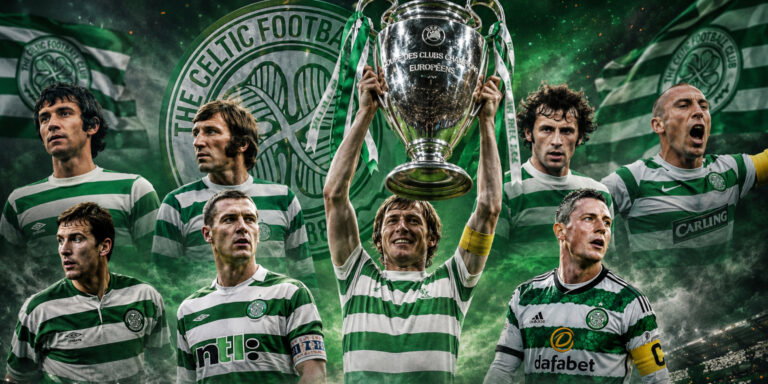
Celtic have been shaped by great players, famous nights and supporters who can turn a routine Saturday afternoon into something bordering on theatre. But behind almost every great Celtic era stands a manager who understood what the job demanded.
That last part matters.
Managing Celtic is not simply about winning football matches. Winning is expected. The team should attack, Celtic Park should feel like Celtic Park, Rangers must be confronted rather than feared, young players should have a pathway and European football should amount to something more than collecting UEFA prize money before Christmas.
It is a fairly unreasonable job description. Celtic managers have been discovering that since Willie Maley took control in 1897.
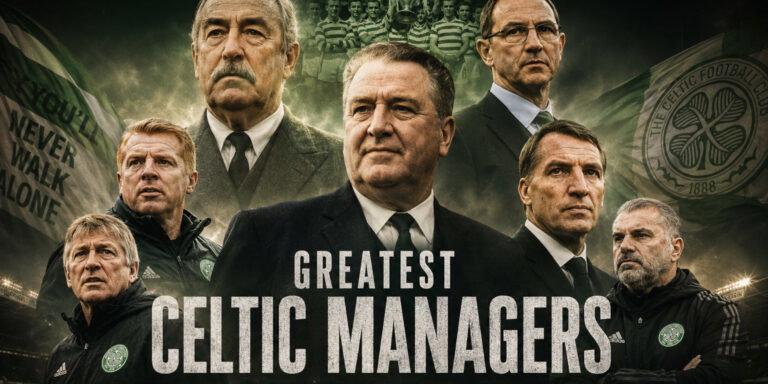
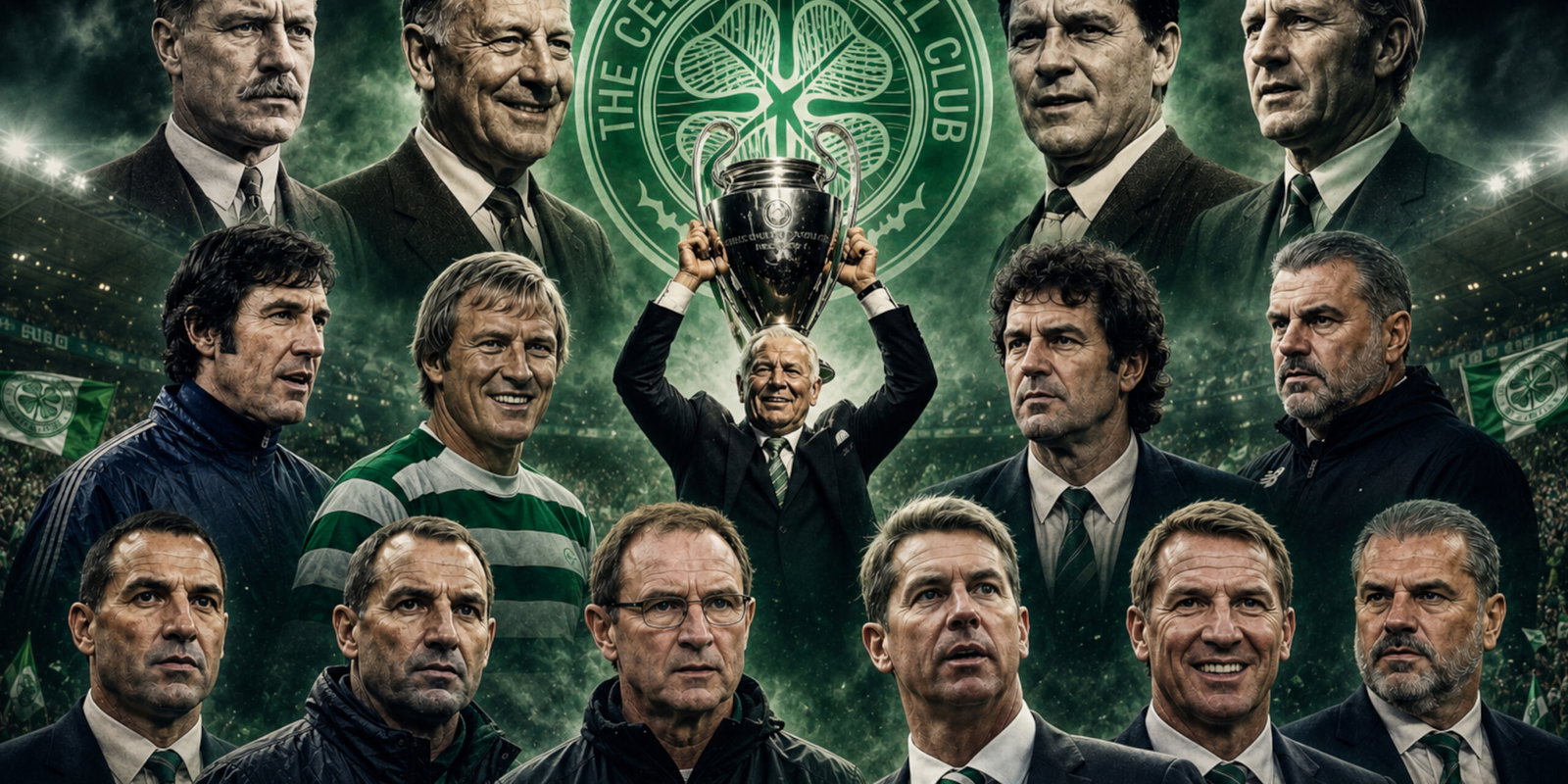
From Maley’s 43-year reign and Jock Stein’s European Cup winners to Martin O’Neill, Gordon Strachan, Brendan Rodgers, Ange Postecoglou and the extraordinary return of O’Neill more than two decades after his first spell, the managerial history of Celtic is really the history of the club itself.
As of October 2026, Martin O’Neill has returned to manage Celtic more than two decades after his first spell. Celtic’s managerial history includes 20 men who have held the permanent managerial role, although several have served across multiple spells and the club was originally run by committee before Willie Maley’s appointment.
Celtic Managers at a Glance
| Manager | |||||||||||||||||||||||||||||||||||||||||||||||||||||||||||||||||
|---|---|---|---|---|---|---|---|---|---|---|---|---|---|---|---|---|---|---|---|---|---|---|---|---|---|---|---|---|---|---|---|---|---|---|---|---|---|---|---|---|---|---|---|---|---|---|---|---|---|---|---|---|---|---|---|---|---|---|---|---|---|---|---|---|---|
Celtic Managers at a Glance
|
* Wartime competitions complicate direct comparison with other Celtic managers.
** McGrory won one league championship, two Scottish Cups and two League Cups. He also won the prestigious Coronation Cup in 1953, which is listed separately from the three principal domestic competitions.
*** O’Neill won seven major trophies during his original spell. Any additional honours from his later tenure must be established from confirmed competition results.
The table immediately shows something interesting. Celtic’s managerial history is not a steady line of progress. It comes in enormous waves.
Maley built the institution. Stein revolutionised it. The late 1980s and 1990s brought instability. Martin O’Neill restored authority. The period from Lennon through Deila, Rodgers and Postecoglou produced another extraordinary concentration of domestic success.
And then, because Celtic occasionally write stories that would be rejected by television producers for being too implausible, Martin O’Neill came back in his seventies.
Before the Managers: Celtic’s Committee Years
Celtic were founded in 1887 and played their first match in May 1888, but there was initially no manager in the modern sense.
Team affairs were handled by committee. That was hardly unusual in Victorian football, when the idea of an all-powerful manager controlling recruitment, tactics and selection had not yet developed.
Celtic were already successful. They won their first Scottish Cup in 1892 and their first league championship in 1893.
The decisive change came in 1897 when Willie Maley was appointed secretary-manager.
From that point, Celtic had something resembling a continuous managerial line.
Willie Maley: The Man Who Built Celtic
Manager: 1897 to 1940
Major honours: 30
Willie Maley did not inherit Celtic as we understand it today. He helped create it.
His 43 years in charge remain one of the most remarkable managerial tenures in British football. Celtic credit him with 16 league championships and 14 Scottish Cups.
Under Maley, Celtic became a national institution rather than an ambitious young Glasgow club.
His first great side dominated the early 20th century, winning six consecutive league championships from 1904/05 to 1909/10. It established a pattern Celtic supporters would become rather fond of: winning several titles consecutively and then arguing that the next one mattered even more.
Maley’s influence went beyond trophies. Recruitment, youth development and an identifiable Celtic football culture became increasingly important.
There is also something almost impossible to comprehend about the length of the reign. A modern Celtic manager surviving four years can feel like a veteran. Maley managed for 43.
Maley’s Celtic record
-
16 league titles
-
14 Scottish Cups
-
43 years in charge
-
Celtic’s longest-serving manager
-
30 major domestic trophies
His numbers are unlikely ever to be replicated because football itself no longer allows managerial reigns of that length.
Jimmy McStay: Managing Through War
Manager: 1940 to 1945
Jimmy McStay inherited Celtic from Maley in circumstances no manager would envy.
The Second World War had transformed Scottish football. Normal national competitions were disrupted and regional competitions replaced much of the regular structure.
Celtic’s official history records McStay’s period without normal major honours, although that requires context rather than simply putting a zero beside his name and moving along. Football during wartime operated under completely different conditions.
His reign represents one of those awkward historical periods where conventional managerial statistics tell very little of the actual story.
Jimmy McGrory: A Great Player in a Difficult Job
Manager: 1945 to 1965
Jimmy McGrory remains one of Celtic’s greatest footballers, but his two decades as manager were considerably more complicated.
There were successes.
Celtic won the league and Scottish Cup double in 1953/54. They won the Coronation Cup in 1953, defeating Arsenal, Manchester United and Hibernian in a prestigious tournament involving leading British clubs.
Then came Hampden in 1957.
Celtic beat Rangers 7-1 in the League Cup final, still one of the most extraordinary derby results in British football.
Yet Celtic underachieved across much of McGrory’s reign. The club’s own historical account points towards boardroom interference in team affairs, something that limited the manager’s authority.
That distinction matters because the Celtic manager as supreme football decision-maker really begins with the next man.
Jock Stein: The Standard Every Celtic Manager Faces
Manager: 1965 to 1978
Major honours: 25
There are successful Celtic managers and there is Jock Stein.
Every serious discussion about the greatest manager in Celtic history ends up here.
Stein returned to Celtic as manager in March 1965. Within weeks he had won the Scottish Cup.
Within two years he had won Europe.
Jock Stein’s Celtic honours
| Competition | Wins |
|---|---|
| European Cup | 1 |
| Scottish league | 10 |
| Scottish Cup | 8 |
| League Cup | 6 |
| Total | 25 |
Stein’s managerial career at Celtic delivered 25 major honours, including the greatest achievement in the club’s history.
The 1966/67 season remains the summit.
Celtic won every competition they entered, including the European Cup by defeating Inter Milan 2-1 in Lisbon. The Lisbon Lions were famously assembled from players born within roughly 30 miles of Glasgow.
That achievement has become so familiar that it is easy to lose sight of how outrageous it actually was.
A Scottish club became European champions playing aggressive, attacking football with a locally produced team.
Stein also delivered nine consecutive league titles between 1966 and 1974, plus another European Cup final appearance in 1970.
For me, this is the dividing line when assessing Celtic managers. Domestic dominance can make someone a great Celtic manager. Sustained European significance elevates the argument.
Stein managed both.
Billy McNeill: Captain, Manager and Celtic Institution
Manager: 1978 to 1983 and 1987 to 1991
Billy McNeill had already lifted the European Cup as Celtic captain. Following Stein was therefore about as close as Celtic could get to maintaining a direct connection with the Lisbon era.
His first spell produced three league championships, a Scottish Cup and League Cup.
The 1979 championship remains particularly cherished. Celtic defeated Rangers 4-2 with ten men to clinch the title.
McNeill returned in 1987 and immediately delivered one of Celtic’s great seasons.
The 1987/88 centenary campaign ended with a league and Scottish Cup double.
There were better Celtic teams statistically, but few championships have felt more perfectly Celtic than that one. Winning a double in the club’s centenary season under the captain of the Lisbon Lions was almost suspiciously neat.
Across his two spells McNeill won eight major trophies.
Davie Hay and the Miracle of Love Street
Manager: 1983 to 1987
Davie Hay followed McNeill and produced two major trophies.
The 1985 Scottish Cup was followed by one of the most dramatic championships in Scottish football history.
Celtic went into the final day of 1985/86 needing to beat St Mirren heavily while hoping Hearts lost at Dundee.
Celtic won 5-0 at Love Street.
Hearts lost 2-0.
The championship belonged to Celtic on goal difference.
Hay’s reign is sometimes squeezed between the larger personalities of McNeill’s two spells, but the 1986 title alone gives him a permanent place in Celtic folklore.
Liam Brady and Lou Macari: Celtic’s Difficult Early 1990s
The early 1990s were grim.
There is little point pretending otherwise.
Liam Brady
Manager: 1991 to 1993
Brady was historically significant as Celtic’s first permanent manager who had not previously played for the club.
It did not work.
There were no trophies, Rangers were becoming increasingly powerful and Celtic suffered a humiliating 5-1 European defeat against Neuchâtel Xamax.
Brady resigned in 1993.
Lou Macari
Manager: 1993 to 1994
Macari arrived during an even deeper institutional crisis.
Celtic were struggling competitively while the club’s ownership battle reached its conclusion. Fergus McCann finally took control in March 1994, rescuing Celtic from financial disaster.
Macari did not survive the new regime.
These managers cannot really be assessed without understanding the organisation around them. Celtic were not merely picking the wrong team on Saturday. The club itself required reconstruction.
Tommy Burns: Celtic Started Feeling Like Celtic Again
Manager: 1994 to 1997
Tommy Burns won only one trophy as Celtic manager.
That sentence manages to be statistically accurate and emotionally misleading.
Burns inherited a club being rebuilt by Fergus McCann while Rangers were chasing sustained domestic domination.
His Celtic side played attacking football and contained wonderful footballers, including Paul McStay, Pierre van Hooijdonk and later Paolo Di Canio and Jorge Cadete.
The 1995 Scottish Cup ended a six-year trophy drought.
Celtic then lost only one league match during the 1995/96 season but still failed to win the championship.
Burns ultimately could not stop Rangers, but he restored belief and style.
As a supporter, I find his managerial record impossible to judge purely through trophies. Some managers win more than they change. Burns changed more than he won.
Wim Jansen: The Man Who Stopped the Ten
Manager: 1997 to 1998
One season.
Two trophies.
One Henrik Larsson.
One stopped ten-in-a-row.
That will do.
Wim Jansen’s Celtic lost their opening two league matches, which was not an especially reassuring start considering Rangers were attempting to win a tenth consecutive championship.
Celtic recovered.
They won the League Cup and then defeated St Johnstone 2-0 on the final day to secure the championship.
Rangers’ ten-in-a-row attempt was over.
Jansen also oversaw the signing of Larsson from Feyenoord for what became one of the great bargains in football history.
Then he left.
It was one of Celtic’s strangest successful managerial reigns.
Jozef Vengloš: Better Than the Trophy Cabinet Suggests
Manager: 1998 to 1999
Dr Jozef Vengloš won nothing at Celtic.
He also signed ?ubomír Morav?ík.
For that alone, I am prepared to hear the defence.
Vengloš inherited a difficult situation following Jansen’s sudden departure. Celtic struggled early but improved significantly, including a famous 5-1 victory over Rangers.
The season ultimately ended trophyless, but Morav?ík and Johan Mjällby became major figures in the successful Celtic side that followed.
Sometimes a manager leaves useful furniture behind.
John Barnes and the Experiment That Failed
Manager: 1999 to 2000
The John Barnes era looked ambitious.
Kenny Dalglish returned as director of football, Barnes became head coach and Celtic possessed considerable attacking talent.
Then Henrik Larsson suffered a broken leg.
Results deteriorated.
The defining moment arrived against Inverness Caledonian Thistle in the Scottish Cup.
Celtic lost 3-1 at home.
Barnes was dismissed.
Dalglish took temporary control and Celtic subsequently won the League Cup, but the experiment was finished.
What followed transformed Celtic.
Martin O’Neill: Celtic Became Powerful Again
First spell: 2000 to 2005
Martin O’Neill arrived in 2000 with Rangers dominant.
A few months later Celtic beat them 6-2.
The psychological shift was immediate.
O’Neill’s first season produced the domestic treble, Celtic’s first since 1969.
His team was physical, experienced and brutally effective. Henrik Larsson reached another level alongside Chris Sutton, while players such as Neil Lennon, Stiliyan Petrov, Paul Lambert, Johan Mjällby and Bobo Baldé gave Celtic a hard competitive edge.
O’Neill’s first spell
-
3 league titles
-
3 Scottish Cups
-
1 League Cup
-
2001 domestic treble
-
2003 UEFA Cup final
Then came Seville.
Celtic defeated Blackburn Rovers, Celta Vigo, Stuttgart, Liverpool and Boavista on their way to the 2003 UEFA Cup final.
Porto won 3-2 after extra time.
Losing still hurts, but reaching that final changed perceptions of Celtic.
For supporters of my generation, O’Neill’s team was the first Celtic side that genuinely seemed capable of walking into major European stadiums and making the opposition uncomfortable.
They did not travel hoping.
They travelled expecting a fight.
Gordon Strachan: More Successful Than He Sometimes Gets Credit For
Manager: 2005 to 2009
Gordon Strachan followed O’Neill, which was not an easy inheritance.
His first competitive match ended in a 5-0 defeat against Artmedia Bratislava.
Things improved.
Rather dramatically.
Strachan won three consecutive league championships, one Scottish Cup and two League Cups.
More importantly from a European perspective, Celtic reached the Champions League last 16 in consecutive seasons.
The 1-0 victory over Manchester United at Celtic Park in 2006, secured by Shunsuke Nakamura’s magnificent free kick and Artur Boruc’s late penalty save, remains one of the defining European nights of the modern era.
Strachan won six trophies.
There have been Celtic managers who inspired more romance, but very few who produced that combination of domestic trophies and Champions League competitiveness.
Tony Mowbray: A Short and Painful Experiment
Manager: 2009 to 2010
Tony Mowbray wanted Celtic to play expansive football.
Unfortunately, Celtic also needed to win matches.
The balance never arrived.
A 4-0 defeat against St Mirren in March 2010 effectively ended his reign.
He left without a trophy.
Neil Lennon stepped in.
Neil Lennon: Two Spells, Ten Trophies and Barcelona
Manager: 2010 to 2014 and 2019 to 2021
Neil Lennon’s managerial story at Celtic is unusually complicated.
His first spell began with rebuilding.
Celtic won the Scottish Cup in 2011 before reclaiming the championship in 2011/12.
Then came Europe.
On 7 November 2012, Celtic beat Barcelona 2-1 at Celtic Park.
It remains one of the great Champions League nights in the stadium’s history.
Lennon won three consecutive league titles before leaving in 2014.
He returned in February 2019 following Brendan Rodgers’ departure and completed the Treble Treble. Celtic subsequently secured another championship and completed the Quadruple Treble by winning the delayed 2020 Scottish Cup final.
Across his two spells Lennon won five league titles, four Scottish Cups and one League Cup.
The disastrous 2020/21 campaign complicates his legacy because Celtic’s attempt to win ten consecutive titles collapsed badly.
But ten trophies cannot simply be edited out of the story.
Ronny Deila: The Bridge Between Eras
Manager: 2014 to 2016
Ronny Deila won two league championships and a League Cup.
His Celtic were particularly impressive defensively in 2014/15, conceding only 17 goals across 38 league matches.
European qualification proved more troublesome, particularly repeated failures to reach the Champions League group stage.
Deila left in 2016.
His period now feels transitional, positioned between Lennon’s first spell and the extraordinary domestic dominance that followed.
Brendan Rodgers: The Invincibles and Eleven Trophies
Manager: 2016 to 2019 and 2023 to 2025
Brendan Rodgers immediately raised Celtic’s domestic level.
His first season was extraordinary.
Celtic went through the entire domestic campaign unbeaten and won the treble.
The 2016/17 Invincibles
Celtic completed all 47 domestic matches without defeat.
They won:
-
Scottish Premiership
-
Scottish Cup
-
League Cup
Rodgers followed that with another treble in 2017/18.
By the time he departed for Leicester City in February 2019, Celtic had won every domestic trophy available during his first spell.
His departure understandably angered supporters, particularly because it happened during the season.
But football has a habit of producing awkward reunions.
Rodgers returned in 2023.
Celtic won the league and Scottish Cup double in 2023/24, followed by another championship and League Cup in 2024/25.
By the end of his second spell, Rodgers had won 11 trophies as Celtic manager: four league titles, four League Cups and three Scottish Cups.
He resigned on 27 October 2025.
Whatever anyone thinks about the circumstances of his two departures, 11 trophies places Rodgers among Celtic’s most successful managers.
The numbers refuse to participate in the argument.
Ange Postecoglou: Rebuilding at Speed
Manager: 2021 to 2023
Ange Postecoglou arrived following the collapse of the ten-in-a-row campaign.
Celtic needed a major rebuild.
Odsonne Édouard, Ryan Christie and Kristoffer Ajer departed. Scott Brown had already left. A substantial new squad had to be assembled.
Postecoglou transformed Celtic remarkably quickly.
Kyogo Furuhashi, Jota, Cameron Carter-Vickers, Reo Hatate, Daizen Maeda and others became central to a fast, aggressive possession game.
Celtic won the League Cup and Premiership in his first season.
The second produced a treble.
Postecoglou’s Celtic record
-
2 league titles
-
2 League Cups
-
1 Scottish Cup
-
1 domestic treble
-
5 major trophies in two seasons
He left for Tottenham Hotspur in June 2023.
It was short, intense and extremely successful.
The Chaos of 2025/26
Even by Celtic standards, 2025/26 was extraordinary.
Brendan Rodgers resigned in October 2025.
Martin O’Neill returned on an interim basis with Shaun Maloney and restored stability. Celtic then appointed Wilfried Nancy in December.
Nancy’s attempt to introduce his football in the middle of a title race failed. Celtic parted company with him in January 2026.
So Celtic called Martin O’Neill.
Again.
What happened next deserves its own section.
Martin O’Neill Returns: One of Celtic’s Strangest Great Stories
O’Neill’s original Celtic career had ended in 2005.
Twenty years later he was back managing the team.
His first interim spell began after Rodgers resigned in October 2025 and ended when Nancy arrived in December.
After Nancy’s departure, O’Neill returned once more in January 2026.
Celtic’s season had been disrupted by repeated managerial changes, but the return of a familiar figure brought another chapter to one of the club’s most significant managerial careers.
O’Neill had already won seven major trophies during his first spell.
His subsequent appointments added an extraordinary new dimension to a Celtic story that had appeared finished more than two decades earlier.
I am not sure anyone watching O’Neill leave Celtic in 2005 imagined we would be discussing him as Celtic manager again in 2026.
Yet here we are.
Who Is Celtic’s Most Successful Manager?
There are several ways of answering this.
Most major trophies
Willie Maley leads with 30 major domestic trophies.
Greatest overall achievement
Jock Stein.
Winning the European Cup changes the argument completely.
Most league championships
Maley won 16.
Stein won 10.
Most successful modern managers
The numbers make for interesting reading:
| Manager | Major trophies |
|---|---|
| Brendan Rodgers | 11 |
| Neil Lennon | 10 |
| Martin O’Neill | 7* |
| Gordon Strachan | 6 |
| Ange Postecoglou | 5 |
| Ronny Deila | 3 |
* O’Neill’s total here covers his original spell from 2000 to 2005. His later managerial tenure is treated separately pending confirmation of its additional honours.
Rodgers therefore has the largest confirmed trophy haul among Celtic managers of the 21st century in this comparison.
Celtic’s Greatest Managers Ranked by Legacy
Trying to rank Celtic managers is asking for trouble, but there are clear historical tiers.
1. Jock Stein
European champion.
Ten league titles.
Twenty-five trophies.
Nine-in-a-row.
Lisbon.
There is no sensible argument against him at number one.
2. Willie Maley
If Stein created Celtic’s greatest team, Maley created the managerial foundations of Celtic itself.
Sixteen championships and 43 years in charge make him essentially incomparable with modern managers.
3. Martin O’Neill
This position has become stronger following his remarkable return.
His first spell restored Celtic as Scotland’s dominant force and took the club to a European final.
More importantly, the 2000 arrival changed the psychology of the club. Celtic stopped looking enviously across Glasgow and started behaving like the stronger team.
4. Brendan Rodgers
Eleven trophies, an unbeaten domestic season, multiple trebles and success across two spells.
Rodgers’ European record prevents him challenging Stein, while the manner of his departures will always colour supporter opinion.
His domestic record, however, is exceptional.
5. Billy McNeill
Eight trophies across two spells and the centenary double.
His significance as a Celtic figure obviously extends far beyond management.
6. Neil Lennon
Ten trophies and one of Celtic’s greatest European victories.
The failure of the ten-in-a-row campaign damaged his reputation, perhaps disproportionately when set against everything that came before it.
7. Gordon Strachan
Three consecutive titles and consecutive Champions League last-16 appearances.
His record looks better with time.
8. Ange Postecoglou
Five trophies in two seasons and one of the fastest successful rebuilds Celtic have produced.
Had he stayed longer, he could have climbed much higher.
The Managers Who Changed Celtic Without Winning the Most
Trophies are essential at Celtic, but they are not the whole measurement.
Tommy Burns won one trophy yet helped restore Celtic’s football identity during an enormously difficult period.
Wim Jansen lasted one season but stopped Rangers winning ten-in-a-row and brought Henrik Larsson to Glasgow.
Ronny Deila helped modernise aspects of training and development before Rodgers accelerated the process.
Even unsuccessful managers can leave something behind.
Football history is rarely as clean as a trophy table.
Celtic’s Managerial Eras
Viewed from a distance, Celtic’s history separates into several distinct managerial periods.
1897 to 1940: The Maley dynasty
Celtic become one of Scotland’s dominant institutions.
1940 to 1965: Instability and underachievement
Wartime disruption is followed by sporadic success under McGrory.
1965 to 1978: The Stein revolution
Celtic become European champions and dominate Scotland.
1978 to 1991: Post-Stein adjustment
McNeill and Hay maintain significant domestic success, although Celtic’s position gradually becomes more difficult.
1991 to 2000: Crisis and reconstruction
Brady, Macari, Burns, Jansen, Vengloš and Barnes oversee a turbulent decade while Fergus McCann rebuilds the club.
2000 to 2009: Celtic become powerful again
O’Neill and Strachan deliver six league titles between them and restore European credibility.
2010 to 2025: Sustained domestic domination
Lennon, Deila, Rodgers and Postecoglou preside over one of the most successful stretches in Celtic history.
Celtic won 13 of the 14 Scottish league championships from 2011/12 through 2024/25.
That is a level of sustained dominance which would have seemed almost unimaginable during the early 1990s.
What Makes a Successful Celtic Manager?
There is a peculiar difference between being a good football manager and being a good Celtic manager.
Success at Celtic demands far more than tactical knowledge or an impressive CV. Winning the league is the minimum expectation, while handling the pressure of the Glasgow derby requires a particular mentality.
Against weaker domestic opposition, supporters expect attacking football rather than simply controlling possession and grinding out results. European competition carries enormous emotional importance, and finishing second in Scotland is never going to be considered an acceptable consolation prize.
Such relentless expectations have overwhelmed talented managers in the past. Those who thrive at Celtic tend to embrace the pressure rather than shy away from it.
Jock Stein understood that better than anyone. Martin O’Neill brought the same mentality, while Brendan Rodgers delivered remarkable domestic consistency. Ange Postecoglou appeared almost energised by the demands placed upon him.
Successful Celtic managers frequently speak about the sheer scale of the club, and with good reason. Understanding Celtic intellectually before accepting the job is one thing. Appreciating what 60,000 supporters expect when St Mirren visit Paradise on a cold February afternoon is something else entirely.
The European Test
Domestic trophies define Celtic managers, but Europe separates the very best.
Stein won the European Cup and reached another final.
O’Neill reached the UEFA Cup final.
Strachan reached the Champions League knockout stage twice.
Lennon’s team reached the Champions League last 16 after beating Barcelona.
Rodgers dominated Scotland but never produced comparable European progress, despite some individual results and Champions League qualification.
Postecoglou’s European football was entertaining but ultimately unsuccessful.
This remains the great challenge for modern Celtic managers.
Celtic’s financial advantage in Scotland means domestic success is expected. In Europe, the economic equation reverses.
The manager suddenly becomes the underdog.
That is why Seville, Barcelona, Manchester United and the European campaigns under Stein remain so important. Those results reveal what a Celtic manager can achieve when resources alone no longer provide the advantage.
The Numbers Behind Celtic’s Managerial Dominance
Celtic had won 55 Scottish league championships by the end of 2024/25.
A remarkable proportion were concentrated under a handful of managers:
| Manager | Celtic league titles |
|---|---|
| Willie Maley | 16 |
| Jock Stein | 10 |
| Neil Lennon | 5 |
| Brendan Rodgers | 4 |
| Billy McNeill | 4 |
| Martin O’Neill | 3* |
| Gordon Strachan | 3 |
| Ronny Deila | 2 |
| Ange Postecoglou | 2 |
| Jimmy McGrory | 1 |
| Davie Hay | 1 |
| Wim Jansen | 1 |
* This counts O’Neill’s league championships during his original 2000–2005 tenure.
Maley and Stein alone account for 26 championships.
That tells you something fundamental about Celtic history. Long periods of success have often been driven by transformational managers rather than gradual institutional progression.
The Celtic Managerial Family Tree
Another striking feature is how often Celtic return to their own people.
Maley played for Celtic.
McStay played for Celtic.
McGrory was a Celtic legend.
Stein captained Celtic.
McNeill captained Celtic.
Hay played for Celtic.
Burns played for Celtic.
Macari played for Celtic.
Lennon played for Celtic.
O’Neill did not, but became so closely associated with the club that his 2025 return felt less like an external appointment than the reopening of an old chapter.
For much of Celtic’s history, familiarity with the club was effectively part of the job specification.
Liam Brady’s appointment in 1991 was significant precisely because he was the first permanent manager who had never played for Celtic.
Modern football has weakened that tradition. Rodgers, Deila, Strachan and Postecoglou demonstrated that outsiders can understand Celtic perfectly well.
The requirement is no longer to have played for Celtic.
It is to understand Celtic quickly.