
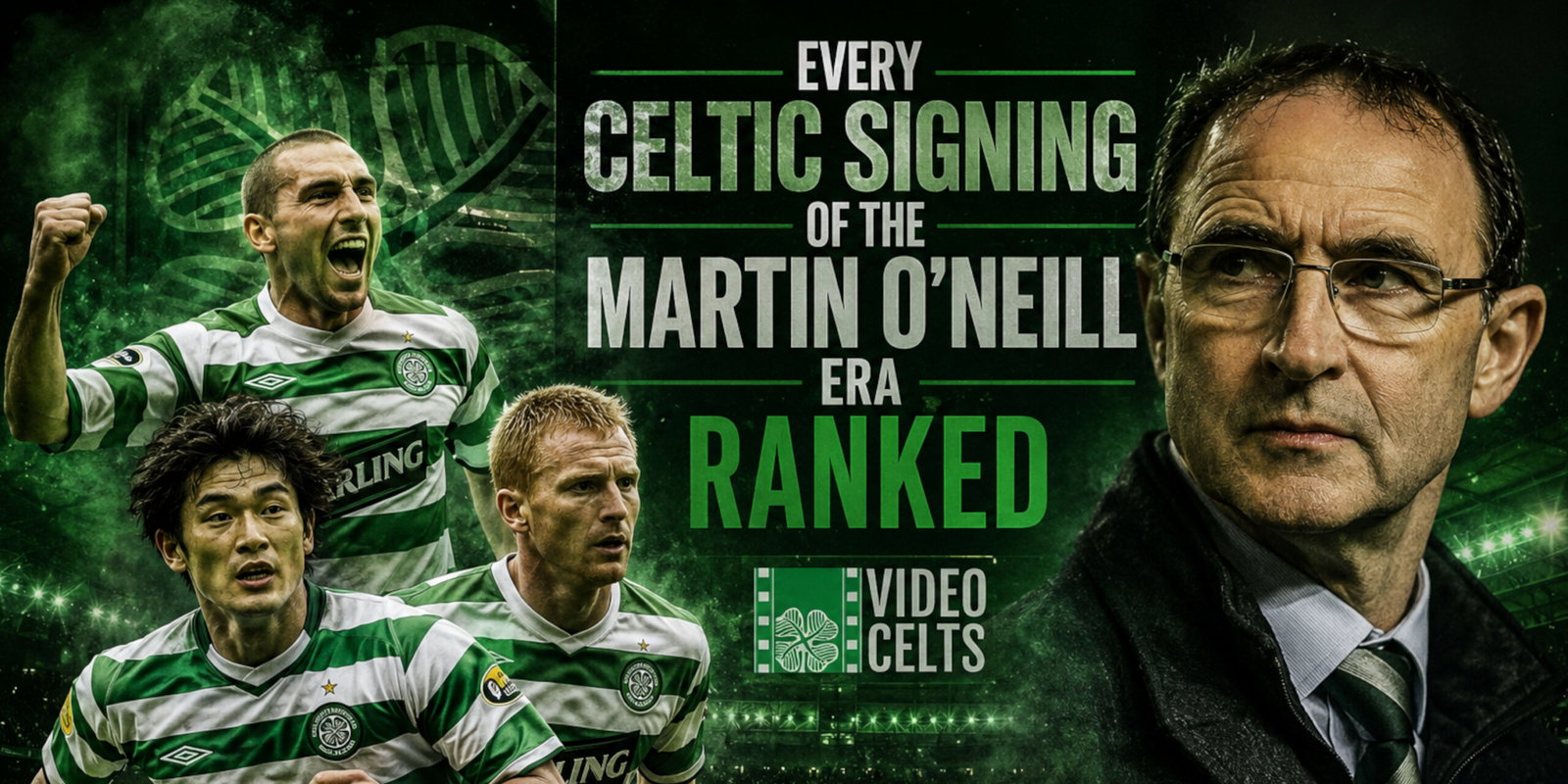
Martin O’Neill did not just sign players. He rebuilt Celtic’s identity.
When he arrived in 2000, Celtic felt noisy, emotional, impatient and occasionally chaotic. Rangers were financially dominant, the squad needed surgery, and supporters were desperate for a team that looked capable of standing tall in Europe again. O’Neill changed that almost immediately. He brought authority, standards and, crucially, recruitment that actually made sense.
Some signings became immortals. Some became dependable warriors. A few looked good for six games before vanishing into the Scottish rain forever.
What stands out now is how deliberate so many of the deals were. O’Neill valued physicality, mentality and experience, but he also knew how to spot quality players who suited Celtic emotionally as much as tactically. His best teams felt huge. Not just in size, but in personality.
This ranking focuses on the major signings of the O’Neill era, weighing quality, impact, longevity, value and influence on Celtic’s modern history.
Chris Sutton
Possibly the most transformative signing of the era.
Celtic paid around £6 million for Sutton in 2000 and many in England thought it was desperation. Instead, he became the perfect O’Neill player.
Aggressive, technically underrated, emotionally combustible and utterly relentless.
His partnership with Larsson remains one of the greatest in British football during that period. Sutton bullied defenders physically while also possessing the intelligence to drift deep and create space. He scored huge goals against Rangers and in Europe, but his mentality mattered just as much.
Old Firm defenders genuinely hated playing against him. Celtic supporters absolutely adored him for that.
Stats only tell part of the story:
- Over 120 goals for Celtic
- Multiple league titles
- Constant influence in big matches
There was edge to Sutton. Celtic had lacked that for years.
Neil Lennon
Some signings become symbols.
Lennon arrived from Leicester City in 2000 for around £5.75 million and instantly gave Celtic midfield control they had badly lacked. He was not quick, he was not flashy and he certainly was not universally loved outside Celtic Park. That last part probably made fans love him more.
His positional discipline allowed others to attack. O’Neill’s side needed structure because so many players ahead of Lennon played aggressively and vertically.
He was the metronome.
What people forget is how technically secure Lennon was. He constantly took the ball under pressure and dictated tempo in European matches against elite opposition.
His resilience off the pitch also deepened his importance to supporters. Lennon represented defiance as much as footballing intelligence.
John Hartson
At his peak, Hartson was terrifying.
Signed from Coventry City in 2001 for around £6 million, he gave Celtic something brutally simple but incredibly effective. If the ball entered the box, chaos usually followed.
Hartson scored over 100 goals for the club and formed devastating combinations with Larsson and Sutton. O’Neill’s forward line often overwhelmed opponents physically before quality took over.
He also produced huge moments:
- Winner against Liverpool at Anfield
- Goals against Rangers in title races
- Crucial European contributions
There were frustrations occasionally. Fitness and mobility could fluctuate. Still, defenders hated facing him and Celtic supporters loved his honesty.
He looked like a striker from another era, which somehow suited O’Neill’s Celtic perfectly.
Alan Thompson
The cult hero choice.
Alan Thompson never received the glamour of Larsson or Sutton, but his influence on that side was massive. Signed from Aston Villa in 2000, he became one of Celtic’s most productive wide players in modern history.
His delivery was outrageously good.
Corners, free kicks and deep crosses repeatedly created goals for Sutton, Hartson and Balde. Thompson also had a habit of scoring enormous goals himself.
Fans still remember:
- 7 Goals against Rangers
- European goals
- Thunderous left foot finishes from distance
Technically, he fit O’Neill’s style brilliantly. Direct, aggressive and productive.
He also carried a bit of snarl about him, which every great Celtic side seems to require.
Bobo Baldé
Pure chaos. Wonderful chaos.
Baldé was not elegant. He occasionally looked one mistimed tackle away from disaster. Yet he embodied the physical dominance of O’Neill’s Celtic.
Signed from Toulouse in 2001, he quickly became a fan favourite because he defended with total commitment. Strikers bounced off him.
European forwards who expected Scottish football to be soft often received an unpleasant surprise.
His partnerships with Valgaeren, Mjallby and Varga gave Celtic genuine authority defensively during the O’Neill years. There were technical limitations, certainly, but Celtic supporters respected his mentality enormously.
Also, Bobo charging forward for set pieces remains one of football’s great stress-inducing spectacles.
Didier Agathe
One of the best value signings in Celtic history.
Signed for a tiny fee from Hibernian in 2000, Agathe became essential almost immediately. His pace changed matches.
There were moments where he seemed physically faster than the entire opposition combined.
O’Neill used him cleverly:
- Right back
- Wing back
- Wide midfielder
Agathe’s technical consistency could frustrate at times, but his athleticism terrified teams in Scotland and created major problems in Europe.
The run against Liverpool in 2003 remains iconic. Anfield rarely saw visiting players carry such threat on transitions.
Joos Valgaeren
An underrated cornerstone of the era.
Valgaeren arrived from Roda JC in 2000 and quietly became one of Celtic’s most dependable defenders. Injuries interrupted his time badly, which probably affects how often he is remembered now.
At his best, he brought calmness to an otherwise aggressive defence.
His positional intelligence complemented Baldé well and he read danger earlier than many gave him credit for. Celtic’s defensive record during O’Neill’s peak years owed a lot to Valgaeren’s consistency.
Stanislav Varga
Varga divided opinion constantly.
At times he looked commanding and composed. At others he appeared moments away from catastrophe. Yet across several seasons he contributed far more than critics admitted.
He performed particularly well during parts of the UEFA Cup run and developed into a useful squad figure.
Not elite, but important.
Juninho Paulista
One of the great “what if” signings.
Juninho arrived on loan in 2004 with enormous pedigree and flashes of quality were obvious immediately. His technical level stood out even in a strong Celtic side.
Unfortunately, injuries and fitness issues limited his influence heavily.
Still, seeing a player of that calibre in a Celtic shirt felt surreal at the time. For older supporters especially, it felt like Celtic were operating on a bigger European stage again.
Ulrik Laursen
A deeply O’Neill-style defender.
Experienced, rugged and fairly uncompromising.
Laursen was never spectacular, but he added depth and reliability during a period when Celtic competed across multiple fronts. He suited Scottish football physically and understood defensive responsibility well.
Not glamorous. Useful.
Rab Douglas
This ranking becomes awkward here because Douglas represented both strengths and frustrations of the era.
He was a solid domestic goalkeeper who contributed to trophies and memorable wins. Yet European matches exposed limitations, particularly under crosses and high pressure situations.
Supporters spent years debating him endlessly.
The truth probably sits somewhere in the middle. Better than critics claimed, not quite good enough for Celtic’s European ambitions.
David Fernandez
Fernandez had moments where he looked genuinely exciting.
Technically gifted and energetic, he contributed well in spells, particularly during the 2002-03 campaign. He added creativity to midfield areas and linked play effectively.
He simply never fully cemented himself long term.
Still, he deserves more appreciation than he usually receives.
Ramon Vega
An intriguing short-term signing.
Vega arrived with reputation and experience from Tottenham Hotspur and contributed during Celtic’s title-winning campaign. Injuries prevented a longer stay, but he brought composure and professionalism when available.
Fans probably remember him more fondly than his appearances total suggests.
The Less Successful Deals
Not every signing worked.
Players like:
- Magnus Hedman
- Momo Sylla
- Henri Camara
- Stephen Pearson
all had varying levels of impact, confusion or disappointment attached to them.
Some simply were not suited to Celtic. Others arrived too late in their careers or struggled with the expectations. O’Neill’s recruitment record remained strong overall, but there were definitely misses once the first great wave of signings faded.
That decline in recruitment depth partly explains why the side eventually lost momentum after Seville.
Why O’Neill’s Recruitment Still Feels Different
What made these signings special was not just talent. It was personality fit.
O’Neill built a side full of leaders, fighters and emotionally durable players. Celtic teams before and after have often possessed technical quality, but very few matched the sheer psychological force of that group.
They looked like they believed Celtic belonged among Europe’s heavyweights.
As a supporter, that feeling mattered enormously. Even defeats in Europe carried pride rather than embarrassment. Celtic Park under O’Neill felt intimidating again.
The recruitment reflected that mentality:
- Strong characters
- Physical presence
- Big game mentality
- Tactical balance
- Genuine connection with supporters
Some football now feels overly sanitised and corporate. O’Neill’s Celtic felt human. Loud, emotional, occasionally flawed, but absolutely unforgettable.
The Takeaway
Martin O’Neill’s signings changed Celtic permanently.
The trophies mattered, obviously:
- Three league titles
- Multiple domestic cups
- UEFA Cup Final appearance
But supporters remember something deeper than medals. They remember belief returning.
Sutton gave edge. Lennon gave control. Hartson gave power. Thompson gave delivery. Agathe gave energy.
Together, they created one of the greatest modern Celtic sides and arguably the last Celtic team that truly looked capable of competing physically and emotionally with Europe’s elite clubs over multiple seasons.
For many fans, this was the team that made them fall in love with football properly.
And honestly, rewatching some of those nights at Celtic Park, it is not hard to see why.






From the little I did see of the match last night, and floods of comments from friends,
it does raise the question: does MON have the ability to change the way the team plays?
That was a surprisingly strong team he fielded last night – if not our best team?
And yet, it seemed like a continuation of the mostly frustrating performances last season?
Might be a bit unfair after 1 match, but even if we do get more / better players brought in,
can MON get the best out of them…?
Got the fondest memories of Agathe.
Unbelievable pace when he turned on the afterburners but also looked so elegant at the same time.
Deffo one of my favs of the last 30yrs.